
Early morning traffic around Nigeria’s busiest airports rarely moves quietly. Engines idle in long lines. Drivers inch forward, watching the gate ahead. Travelers in the back seats glance nervously at their watches, calculating how much time they have left before boarding begins.
On Thursday, March 13, the familiar scene at two of Nigeria’s major airports carried a different kind of attention.
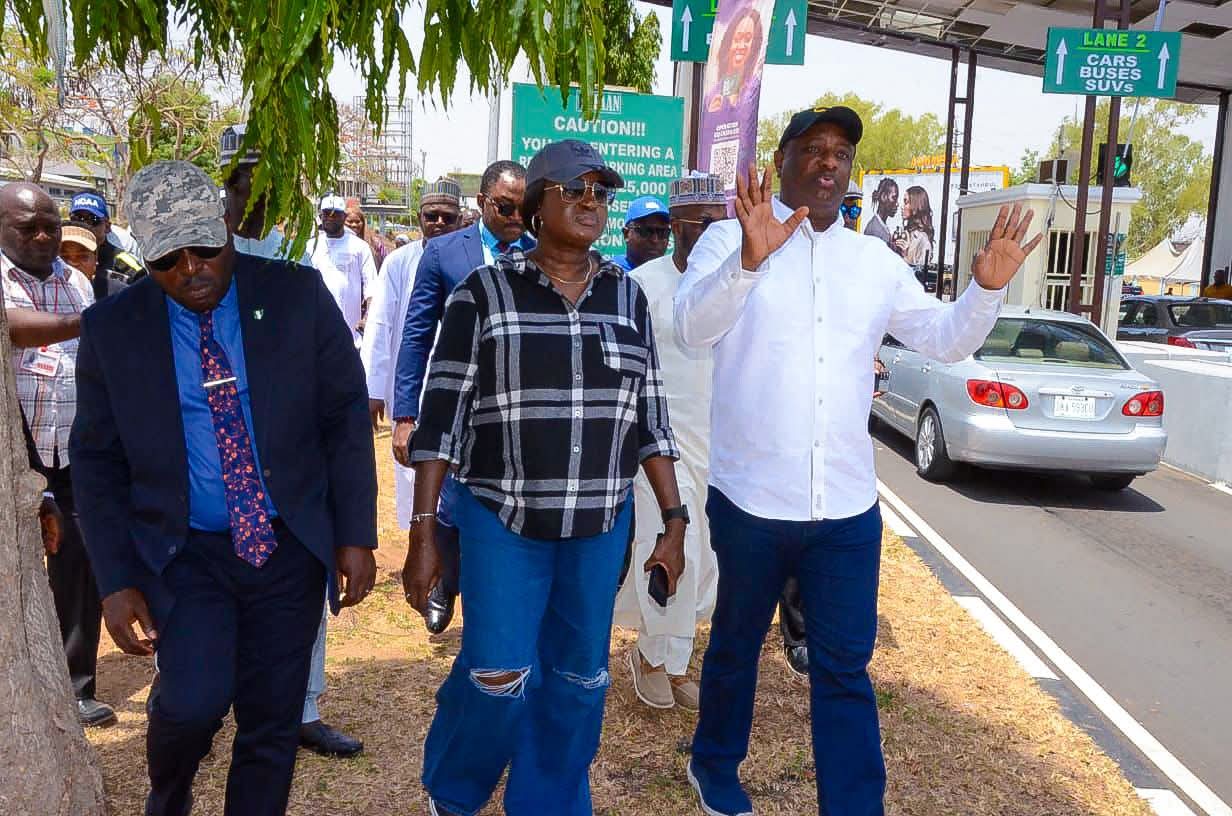
At Nnamdi Azikiwe International Airport and Murtala Muhammed International Airport, officials gathered at the access gates to observe something that might appear ordinary to most travelers: cars entering the airport. But this was no routine moment. It was an inspection that reflects a broader effort to modernize how Nigeria’s airports manage traffic and payments.
Leading the visit was the Honourable Minister of Aviation and Aerospace Development, Festus Keyamo, accompanied by the Managing Director and Chief Executive Officer of the Federal Airports Authority of Nigeria (FAAN), Olubunmi Kuku. Their goal was to assess traffic flow following the introduction of FAAN’s new hybrid payment collection system at airport access gates.
The system allows drivers to pay either digitally or with cash—an approach designed to balance convenience with accessibility as Nigeria’s aviation sector gradually embraces more automated processes.
Standing near the entrance lanes, watching vehicles filter through the gates in a steady rhythm, the minister observed how the system was performing under real-world pressure. The results, he suggested, were encouraging. Keyamo commended FAAN’s hybrid payment approach, noting that it was already helping facilitate smoother vehicular movement into the airport.

For many airport users, the entrance gate is often the first test of patience. A few extra minutes stuck in traffic can mean added stress before a flight. Improvements at this point—however small they may seem—can ripple through the entire travel experience.
Yet the visit was not only about celebrating progress; it was also about refining the system. During the inspection, discussions turned to the possibility of introducing a dedicated detour lane for cash payments. Such a lane would allow drivers paying with physical cash to move through a separate channel, reducing delays for those using electronic payment methods and minimizing traffic disruptions during peak periods.
It’s a practical idea rooted in everyday observation: when different payment types compete for the same lane, delays can easily build up. Separating them could help maintain vehicle flow, particularly at airports that process thousands of vehicles daily.
Beyond these immediate improvements lies a more ambitious vision. In the long term, FAAN aims to deploy fully automated access gates, where payment verification and entry processes happen seamlessly, reducing human bottlenecks and speeding up vehicle access.
Across the global aviation industry, automation is increasingly shaping how airports operate—from self-service check-ins to biometric boarding gates. Extending this efficiency to airport entry points is a natural next step.
For Nigeria, where major airports serve as critical gateways for business, tourism, and international travel, such modernization efforts carry national significance.
The inspection at Abuja and Lagos may have lasted only a short while, but it reflects a larger commitment by FAAN to improve operational efficiency, reduce congestion, and enhance the overall experience for airport users.
For the drivers who pass through those gates every day, the difference may eventually be felt in something simple: fewer minutes waiting in line, a smoother drive into the airport, and a journey that begins with less friction.
Sometimes, the future of travel does not begin on the runway or inside the terminal.
Sometimes, it begins at the gate.
Samuel Opoku
