
This was the story I told in 2014. The 3 Legacy Projects outlined in 2014 are almost in Play. The Power of Vision.
Enjoy the Story
Travelling all over Africa has been my lifelong passion. And now another opportunity just attended my way to experience Rwanda. Many things make Rwanda a land to visit and explore.
And having been officially invited by the government of Rwanda as one of the international delegates to take part in the country’s annual Kwita Izina, the popular gorilla naming ceremony, I quickly knew that it was an opportunity for me to explore the country they call a land of a thousand hills’.
The journey was all fun I took my journey aboard the Rwandair, the official airline of Rwanda. Though a young airline, Rwandair has done giant things. I remember that the CEO of the airline, John Mirenge, told a motley crew of tour operators and journalist from all over Africa in his office at the Kigali international Airport that, “In 2016 we will launch our Dreamliners B787 on long haul routes”. Presently flying point to point to 16 destinations Rwandair plans to add more destinations and build more routes using bigger airplanes to serve more people in the coming years.
READ: Ikechi Uko, Rwandair CEO, others names Baby Gorillas at 10th Kwita Izina in Rwanda
The airline’s growth plan is part of the Afrocentric policy of the government and people of Rwanda. Rwanda is the first African country to issue visa on arrival to anyone with an African Passport. Rwanda allows 5th freedom rights to airline from other countries in respect of the much abused Yammassoukoru Declaration. Most African countries signed onto this Accord that will allow African Airlines fly freely within Africa but most have refused to implement it. Not only has Rwanda implemented this YD accord it has positioned itself to benefit from it.
It was also revealed to us on arrival that Rwanda has three major Legacy projects, the almost completed Convention Centre, Rwandair and the new Bugasera Airport. Of all the three Legacy projects Rwandair is the most known and has not failed in extending the image and brand of a brand new country Rwanda.
So, let me go back to my flight experience of Rwandair. Looking down from the lofty height from inside the aircraft’s window, after the pilots asked us to fasten our seat belt and get ready as the plane was about landing, the scenery of the country comprising a lot of hills and beautiful green vegetation enmeshed with uplands that dotted about the whole country was quite a sight I cannot forget in a huury.
From the winding valleys to the mountain tops; from the breathtaking sceneries on top crests of highlands; the annual gorilla naming festivals to beautiful ballet dancers of the Rwanda national dance troupe, and the recent revelation that women own more lands in Kigali: all culminate in making the country a promise land to behold!
On a tour of the country, I came to the conclusion that Rwanda is a strange country to most people. Over the years the only thing most of us knew about Rwanda was the genocide. Driving through the city of Kigali, I concluded that it is the neatest capital city in Africa. It is a city with no “Pure water” sachets littering the streets, no beggars on the street. It looked too controlled to be real but it’s true.
Our tour guides, Anne and Florence made sure we that in Rwanda you follow rules. Everything has a rule and Rwandans follow rules. They looked like a seal claque to most of us used to the rowdiness of Lagos, Nairobi and Jo’burg. We even started wondering if they were not secretly controlled maybe by a device, it looked that surreal. Seeing 40,000 people clap and keep quiet at the same time during the gorilla naming ceremony at Kinigi, and coupled with the fact that there was no police or military around at the event looked ‘unAfrican’.
While we discussed among ourselves as tourists, after taking cognizance of the various unique and praise-worthy strides the once war-torn country has achieved in just twenty years, all of us agreed that Africa needs to look towards Rwanda to reinvent itself. After the genocide they had an opportunity to start afresh and they have made a huge success of it. They changed their official Language from French to English (this is incredible) though with a lot of hiccups it is done. There is universal health insurance in Rwanda. No one is allowed to walk bare footed.
With some of the most beautiful ladies in Africa, the land of a thousand hills offers so much to the traveller. And dynamism of culture is favouring the ladies in Kigali. Old paradigms that forbid women from owning lands in Africa are giving ways to reforms in the country. Land ownership is a reflection of economic power in most societies. In most African cultures, it is customary and traditional for men to be the owners of lands. But with a new finding, this paradigm does not hold in Kigali, capital city of Rwanda, as women are well ahead of men as land owners. Women own 52% of city land in Kigali and they have 40% of all government positions. (The men seemed endangered to me)
So, women now own the highest number of registered plots in the city, according to new figures from the department of Lands and Mapping. Statistics show that women own land either as individuals or in equal partnership with their husbands—a development that counters archaic cultural norms that previously denied women the right to own land. A report presented Friday, during the launch of land registration month in Kigali, indicated that public awareness towards securing land rights and titles has reduced land-related conflicts.
One other attraction you get in Rwanda is the Gorilla Trek. The Gorilla Trek is world famous but the history of the kingdom especially King Musinga and his son Rudihingwa whose conversion to Catholicism ended the Dynasty will interest the tourist. A visit to see the palace and the famous Nyambo cows must not be missed. These Royal cows are treated like kings and they grow horns of gigantic proportions. It is said that the graceful Rwandan ballet dance is copied from the movement of the Nyambo cows.
The museum of ethnography is rich in history and the sociology of the Rwandans. You cannot understand the country without passing through the museum. It is rich and enlightening.
Lake Kivu is the centre of attraction for the visitor. From the lakeside resorts on the lake you can visit the caves of Musanze and the volcanic mountains around it. The other side of the lake is Congo DRC and just 25kms down the road is Uganda.
The terraced farming landscape of the environs is a pleasure to behold. Tea, wild tomatoes, carrots and cabbages are common sights as you drive by. Don’t forget the rice paddies created by the side of the hills.
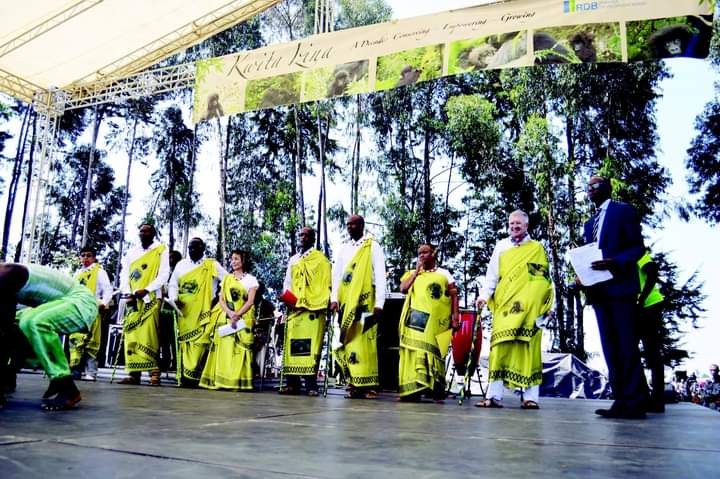
The gorilla naming ceremony is an annual event in which Rwandans celebrated the birth of baby gorillas every year. This year’s celebration was 10th Anniversary of Kwita Izina, for the celebration of the birth of 18 new baby gorillas. The event was held at the foothills of the Virunga Mountains in Kinigi, Northern Rwanda, and brought together more than 40,000 residents of Musanze District and visitors from all over the world. This year’s Kwita Izina was held under the theme: “A Decade: Conserving-Empowering-Growing”, with emphasis on how gorilla tourism empowers communities through revenue sharing programs.
One must appreciate the excitement the people exhibits about this event. But to clear the confusion of a novice was when the Prime Minister, Dr. Pierre Damien Habumuremyi, explained the importance of Kwita Izina, saying that conserving their nature is integral to the country’s development agenda. And that the local residents are the primary beneficiaries as it has helped set up community businesses and income generating projects that has improved lives and the communities’ economy.
I was very thrilled, and for the first time truly came face-to-face with the need for the conservation of endangered animals. The celebration actually marked the growth of the gorilla family by naming 18 baby gorillas born over the last year, bringing the total population of the endangered species to over 600 in the Virunga Transboundary Parks.
To me, it was really fun when I discovered the meaning of the names given the gorillas as I really laughed. The baby gorillas were named:
Nkurunziza – translated “good news”
Inkindi – translated “clothe of high value”, referring to the value that mountain gorilla have in Rwandan economy.
Inzozi – translated “dreams”
Tebuka – translated “be quick”
Ubukwe – translated “celebrations, festivity, party”, because mountain gorillas are the wealth of the country through tourism.
Birashoboka – translated “It is possible”.
Masunzu – In reference to an area within the Volcanoes National Park called Masunzu and it is where he was born.
Nakure – translated “Grow up”
Kwigira – translated “self-reliance”
Imikino- translated “competitive activity or sport played and highlights this year’s Kwita Izina coincidance with the 20th edition of FIFA world cup in Brazil.
Twiyubake – “self-reliance”
Ndengera- translated “Protect me”
Kwigira –translated “Self-reliance”
Ubugeni- translated “Arts and Crafts”
Isange- translated “Welcome”
Umutaka- translated “Umbrella”
Kundurwanda- translated “Love Rwanda”
Ubukombe- translated “Experience”
Ibendera- translated “flag”
Kwita Izina is inspired by the ancient Rwandan tradition of naming babies soon after they are born. In the nine years since the event was established, 163 gorillas have been named in a celebration of nature and the communities who protect the majestic mountain gorilla.
For the whole event and the fun I had I only had regret: I did not remember asking the locals and government functionaries how they intend to remember which gorilla has what names, as all of them actually looked alike to me.
One other attraction you get in Rwanda is the Gorilla Trek. This is world famous but the history of the kingdom especially King Musinga and his son Rudihingwa whose conversion to Catholicism ended the Dynasty will interest the tourist. A visit to see the palace and the famous Nyambo cows must not be missed. These Royal cows are treated like kings and they grow horns of gigantic proportions. It is said that the graceful Rwandan ballet dance is copied from the movement of the Nyambo cows.
The museum of ethnography is rich in history and the sociology of the Rwandans. You cannot understand the country without passing through the museum. It is rich and enlightening.
Lake Kivu is the centre of attraction for the visitor. From the lakeside resorts you can visit the caves of Musanze and the volcanic mountains around it. The other side of the lake is Congo DRC and just 25kms down the road is Uganda.
The terraced farming landscape of the environs is a pleasure to behold. Tea, wild tomatoes, carrots and cabbages are common sights as you drive by. Don’t forget the rice paddies created by the side of the hills.
The gorilla naming ceremony is an annual event in which Rwandans celebrate the birth of baby gorillas every year. This year’s celebration was 10th Anniversary of Kwita Izina, for the celebration of the birth of 18 new baby gorillas. The event was held at the foothills of the Virunga Mountains in Kinigi, Northern Rwanda, and brought together more than 40,000 residents of Musanze District and visitors from all over the world. This year’s Kwita Izina was held under the theme: “A Decade: Conserving-Empowering-Growing”, with emphasis on how gorilla tourism empowers communities through revenue sharing programs.
One must appreciate the excitement the people exhibit about this event. But to clear the confusion of a novice was when the Prime Minister, Dr. Pierre Damien Habumuremyi, explained the importance of Kwita Izina, saying that conserving their nature is integral to the country’s development agenda. And that the local residents are the primary beneficiaries as it has helped set up community businesses and income generating projects that have improved lives and the communities’ economy.
I was very thrilled, and for the first time truly came face-to-face with the need for the conservation of endangered animals. The celebration actually marked the growth of the gorilla family by naming 18 baby gorillas born over the last year, bringing the total population of the endangered species to over 600 in the Virunga Transboundary Parks.
To me, it was really fun when I discovered the meaning of the names given the gorillas as I really laughed.
For the whole event and the fun I had, I only had a regret: I did not remember asking the locals and government functionaries how they intend to remember which gorilla has what names, as all of them actually looked alike to me.
