

At the 2025 FAAN National Aviation Conference (FNAC), held at the Eko Hotel and Suites, Lagos, Chief Executive Officer of Ibom Air, Mr. George Uriesi, delivered a hard-hitting paper on “Airline Profitability and Cost Optimization,” spotlighting the enormous financial pressures facing Nigerian carriers and the structural reforms urgently needed to sustain the sector.
Describing airline operations in Nigeria as “navigating an obstacle course,” Uriesi said the industry is burdened by high-cost aircraft financing, heavy dollar-denominated expenses, underdeveloped infrastructure, and escalating taxes and charges — all of which severely weaken profitability.
The Ibom Air boss while contrasting the Nigerian airline ecosystem with global markets, noted while European carriers can secure aircraft financing at 3–4% interest over 15 years, Nigerian operators often pay around 30% interest for a maximum of seven years.
“The same Airbus A220 my colleague in Europe pays $100 monthly for, I am paying $500,” Uriesi said, emphasizing the disproportionate financial pressure borne by Nigerian airlines.
Heavy Dollar Costs, Infrastructure Challenges
Uriesi highlighted the “naira versus dollar” reality, where airlines earn in naira but pay nearly all major expenses — maintenance, insurance, aircraft leases — in dollars.
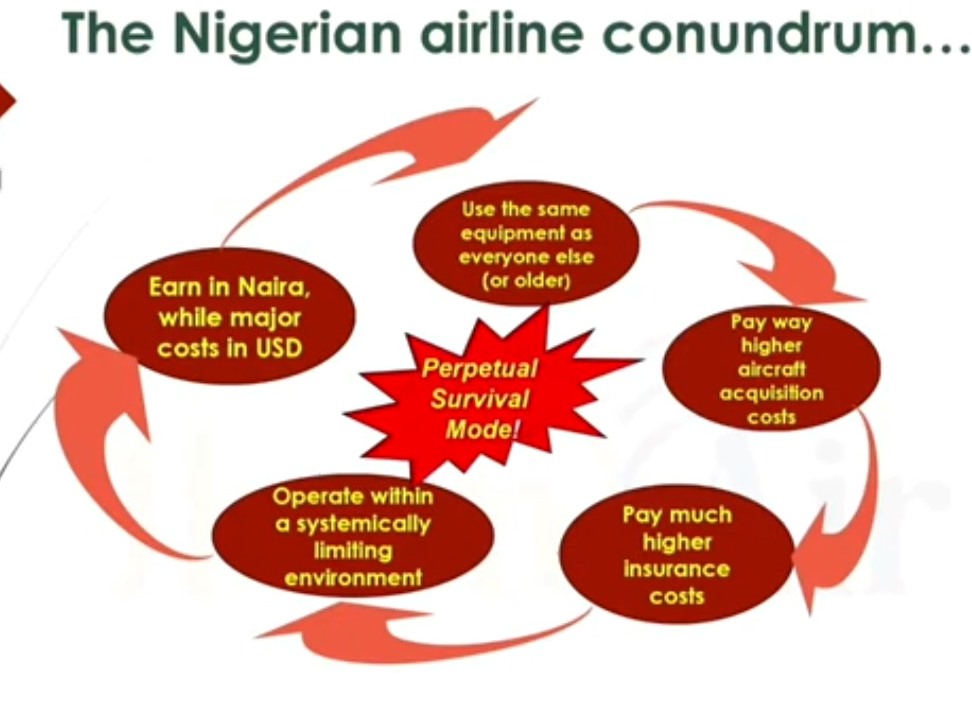
Insurance premiums alone, he said, are often double what European airlines pay, despite identical aircraft and operational risks.
Infrastructure gaps also weigh heavily on operations. He cited Abuja’s ongoing air traffic delays, where reliance on procedural (non-radar) airspace management during peak hours forces aircraft into prolonged holding patterns.
“Flights are sitting 20 minutes on the ground and longer in the air — the fuel impact is huge. How do airlines get profitable like that?” he asked.
Taxes, Charges and the Burden of Regional Flying
Using the Lagos–Accra route as an example, Uriesi disclosed that an airline pays about $185 in taxes before even adding the ticket fare — a figure set to reach $200 by December with new NCAA charges.
“Before you price your ticket, you already owe $200. How do you fly in Africa like this?” he quipped.
He also warned that maintenance costs abroad have become unsustainable, with C-checks estimated at $1.5 million but often rising to $3–4 million once completed.
Major Operational Losses From Underutilization
One of the most striking revelations came from aircraft utilization data.
While global airlines typically achieve 10 hours of aircraft use per day, Nigerian airlines average 5.5–6 hours, resulting in 720 fewer flights per aircraft annually.

With each flight generating roughly ₦5 million, Uriesi calculated the annual loss at:
- ₦3.6 billion lost per aircraft per year
• Ibom Air, with 9 aircraft, loses about ₦32.4 billion annually from underutilization alone
“These are the things stopping us from unleashing the industry’s potential,” he said.
Call for Reforms: Financing, Maintenance, Taxes, and Scale
Uriesi outlined key reforms needed to stabilize the sector:
- Cheaper aircraft financing, which he called the “biggest problem” eating directly into profits.
- Domestic aircraft maintenance capability, to end the “unsustainable” dependence on costly foreign MROs.
- Reduced regulatory fees and charges, which “take a huge toll” on operational viability.
- Lower regional charges, which make African flying “a daunting experience.”
- Airline consolidation and growth, warning that “small airlines of 3–5 aircraft will not survive.”
“Being small is the most dangerous thing an airline can be,” he stressed. “You need 10, 15, 20 aircraft to have a chance at sustainable profitability.”
Despite All Challenges… Airlines Still Deliver
Uriesi closed on a positive note, revealing that Ibom Air has maintained an 88% compounded annual growth rate in revenue since 2019 and remained profitable despite overwhelming headwinds.
“We still made profit in 2024 and I believe we will again in 2025. But imagine what we could do without these burdens,” he said.
The presentation was one of the major highlights of FNAC 2025, drawing attention to the urgent need for policy intervention, industry collaboration, and targeted reforms to secure the future of Nigeria’s aviation sector.
