
The ability of citizens to participate in public affairs and hold government institutions accountable is increasingly viewed as an important indicator of a country’s civic and economic environment.
According to africa.businessinsider.com, across Africa, differences in civic space can reveal how freely people engage with public institutions, exercise their rights and influence decisions, offering valuable signals to investors, businesses and citizens about the strength of accountability and participation.
From political participation and freedom of association to access to information and public oversight, countries with stronger civic spaces can provide citizens with greater opportunities to shape government policies and demand institutional accountability.
Civic space encompasses three essential freedoms: expression, peaceful assembly, and association, as well as the government’s obligation to defend them.
READ: News: Namibia Expands Visa-on-Arrival Access to 28 African Countries, As Nigeria is Left Out
A healthy civic space may give significant benefits to African economies.
This analysis can aid in identifying issues before they become more expensive to repair.
It also allows governments to receive feedback from communities affected by important programs and infrastructure projects.
Investors aren’t just concerned with tax rates, natural resources, and market size, but also how easily these factors can be influenced.
A country that allows entrepreneurs, media, and civil society to freely criticize government choices can foster more transparency and public accountability, and by extension be more alluring to investors.
A good civic space allows affected groups to legitimately express their concerns, negotiate with authorities, and participate in decisions that impact them.
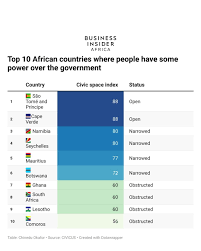
According to CIVICUS, 44 of 50 nations and territories in Sub-Saharan Africa are classed as blocked, repressed, or closed, with over 80% of the region’s people living in countries where civic space is repressed or closed.
Only Cabo Verde and São Tomé and Príncipe are considered open.
However, there are indicators that things can improve.
For example, Senegal, Gabon, and Mauritania improved in the most recent evaluation, demonstrating that civic circumstances may improve when governments implement reforms and provide more room for civil society.
With that said, here are the African countries that boast the top civic space, as defined by CIVICUS, ranked 1 to 100, with 100 representing the best civic space and 1 the worst.
The CIVICUS Monitor uses data from civil society organizations, international indexes, research teams, and its own specialists to define nations as open, constricted, blocked, repressed, or closed. It noted that its “annual report, People Power Under Attack, rates the state of civic space conditions based on data collected throughout the year from country-focused civil society organisations, regionally-based research teams, international human rights indices and the CIVICUS Monitor’s in-house experts.”
