
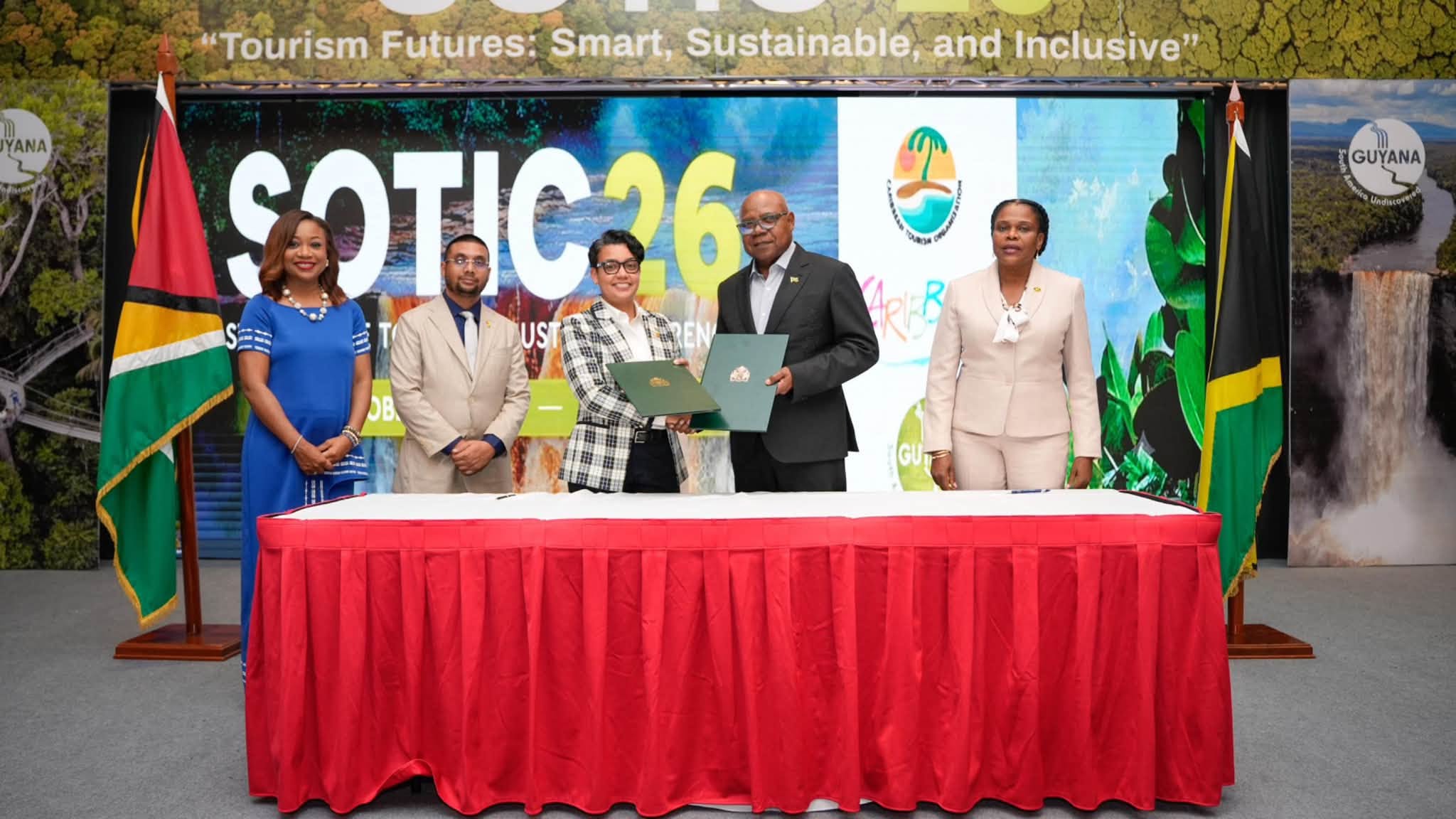
Caribbean tourism leaders have concluded a landmark regional conference in Guyana with a tourism agreement, renewed calls to expand luxury travel offerings and criticism of European Union visa restrictions, as destinations across the region seek stronger cooperation, increased investment and easier international travel.
The five-day conference, held from October 5th to 9th at the Atlantic Suites by Hyatt under the theme “Tourism Futures: Smart, Sustainable and Inclusive”, included ministerial sessions, industry panels, a new research forum, youth programming and the signing of a bilateral tourism agreement between Guyana and Jamaica.
Opening the formal public programme on October 7th, Guyana’s Minister of Tourism, Industry and Commerce, Susan Rodrigues, announced that Guyana recorded 360,623 visitor arrivals during the first nine months of 2026. She said the figure builds on a record full year in 2025, when Guyana welcomed 453,489 visitors, a 22 per cent increase on 2024. (DPI Guyana, October 7th 2026)
Minister Rodrigues attributed the growth to deliberate infrastructure investment, noting the addition of 12 new airlines since 2020 connecting Guyana to North America, Europe, the Caribbean and South America, as well as the entry of nine internationally branded hotels into the market. She said Guyana hosted more than 18 conferences and major business events in 2026, a sign of its growing profile as a destination for meetings, incentives, conferences and exhibitions.
She said the government’s tourism strategy is designed to extend economic benefits beyond the hospitality industry, citing farmers, fishermen, taxi drivers, tour guides, artisans, entertainers and small business owners as intended beneficiaries of tourism growth. (DPI Guyana, October 7th 2026)
Call for a Luxury Pivot and EU Visa Concerns
Delivering the keynote address at the conference opening, Guyana’s President, Dr Mohamed Irfaan Ali, urged Caribbean nations to pursue a higher-value tourism strategy and raised concerns about European Union (EU) visa procedures affecting Caribbean travellers.
On tourism strategy, President Ali pointed to the Middle East as an example for the Caribbean to study, citing that region’s focus on luxury resorts and hospitality that compete on quality, and its success in attracting major international events in sports and entertainment. He challenged the CTO and delegates to examine global tourism trends and develop a strategic plan for the long-term competitiveness of Caribbean tourism. “We have to go bigger,” he said. (Guyana Times, October 8th 2026) His remarks were recommendations to the conference; they were not formally adopted as a regional position during the event.
On EU visa procedures, President Ali said Caribbean citizens currently have to travel to other countries, such as Trinidad and Suriname, to complete biometric requirements for some visa applications. He described this as incompatible with the era of digital technology and a barrier to building tourism partnerships and attracting visitors to regional events.
“In a day of digitisation and AI, we have the EU that is operating from a Stone Age kind of operation,” President Ali said. “We can’t build partnership and friendship like that, where people gotta spend four days to get a visa before they travel to your country.” (Guyana Chronicle, October 9th 2026)
In response, the EU Ambassador said the EU would work towards tangible results on Schengen visa concerns for Caribbean travellers, though no specific reforms, timelines or commitments were announced. (Kaieteur News, October 10th 2026)
Guyana–Jamaica Tourism Agreement
On October 9th, the closing day of the conference, Minister Rodrigues and Jamaica’s Minister of Tourism, Edmund Bartlett, signed a Memorandum of Understanding (MOU) on tourism cooperation between Guyana and Jamaica, in the presence of Jamaica’s Permanent Secretary for Tourism Jennifer Griffith, Guyana Tourism Authority Director Kamrul Baksh and CTO Secretary-General and CEO Dona Regis-Prosper. (INews Guyana, October 9th 2026)
The MOU sets out a framework for the two countries to share knowledge and expertise, strengthen engagement between tourism stakeholders and encourage travel between the two destinations. It provides a basis for collaboration in tourism investment, air connectivity, education and training, sustainable tourism development and tourism resilience. Any specific programmes, investments or connectivity outcomes arising from the agreement remain subject to future negotiation and implementation between the two governments.
Speaking at the signing, Minister Rodrigues said the agreement provides an opportunity for both countries to strengthen tourism ties and share expertise. Minister Bartlett said the partnership with Guyana, as an emerging destination, would add value to Caribbean tourism integration and to multi-destination tourism strategies. He said the focus should move beyond visitor arrival numbers towards ensuring tourism delivers greater value to local economies. (INews Guyana, October 9th 2026)
Elsewhere at the Conference
Ministers met on October 8th for a high-level session titled “Competing for Tomorrow”, which addressed destination competitiveness and the strategic direction of Caribbean tourism in the medium term. Minister Rodrigues led the session as host minister, while Barbados’ Minister of Tourism and International Transport, G.P. Ian Gooding-Edghill, served as Chairman of the CTO Council of Ministers and Commissioners of Tourism. (Travel and Tour World, October 5th 2026; SOTIC official website)
The CTO also used the conference to launch the inaugural Caribbean Tourism Research Forum, a platform intended to advance research and evidence-based decision-making in Caribbean tourism. The three-hour forum, held on October 7th, brought together academics, researchers, tourism practitioners, destination representatives, development partners and students to share findings and discuss practical solutions to regional tourism challenges. (CTO official, onecaribbean.org)
Data and technology were recurring themes. Several sessions addressed their use in tourism management and marketing, including an Amadeus Big Data Workshop on how travel intelligence can inform destination strategy, and multiple speakers cited artificial intelligence and digital tools as areas requiring greater investment and capability across Caribbean destinations.
On October 8th, the Regional Tourism Youth Congress, sponsored by Carnival Corporation, brought together Junior Ministers and Commissioners of Tourism aged 14 to 17 from across CTO member countries. A Future Leaders Forum earlier in the week gave students and emerging professionals the opportunity to engage directly with senior industry figures. (SOTIC official website; CTO official)
The conference was hosted by Guyanese-American journalist and media executive Melissa Noel. Official partners included Amadeus and the Inter-American Development Bank as conference partners, ASM Global Route Development as Tourism Intelligence Awards sponsor, the Association of Value Airlines as contributing sponsor, Carnival Corporation as Youth Congress sponsor and interCaribbean Airways as Official Airline Partner. (CTO official; Breaking Travel News, September 24th 2026)
CTO business meetings, including sessions of the Board of Directors and the Ministerial Council, took place on October 5th and 6th. The main conference ran on October 7th and 8th, followed by destination media briefings on October 9th, the closing day on which Guyana and Jamaica signed their tourism MOU.
