
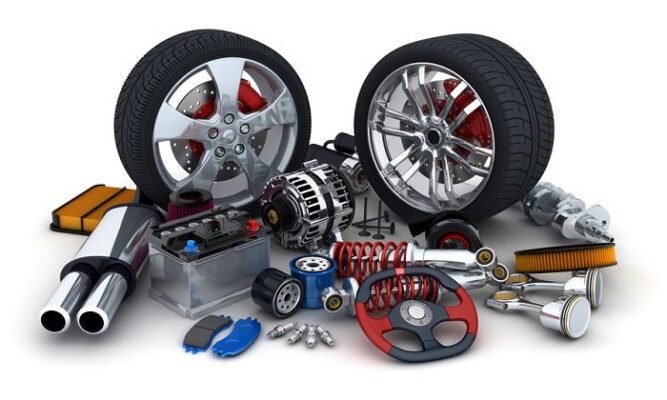
Nigeria’s fast-expanding automotive sector is driving a surge in demand for vehicle components, unlocking a $5 billion spare parts market ripe for investment.
As imports continue to dominate supply, industry stakeholders say the gap presents significant opportunities for local manufacturers and international investors to scale production, strengthen supply chains, and capture value in one of Africa’s largest mobility markets.
According to businessday.ng, the country has grown into one of Africa’s largest automotive aftermarket industries, importing an estimated $5 billion worth of both Original Equipment Manufacturer (OEM) components and second-hand spare parts annually.
With the right investment and infrastructure, Nigeria’s automotive industry could reduce its reliance on imports and create jobs.
“Nigeria’s automotive spare parts market is estimated at approximately $5–$6 billion annually. Of this, roughly 70–80 percent consists of new OEM and aftermarket components,” said Okpamen Obasogie, mechanical engineer and industrial designer.
“While an estimated 20–30 percent comes from second-hand (tokunbo) parts, reflecting the dominance of used and aging vehicles in the country,” Obsogie added.
The growing demand for vehicle maintenance is creating investment opportunities across Nigeria’s automotive aftermarket, particularly in local component manufacturing, distribution networks to improve product traceability, and reduce the circulation of counterfeit parts and vehicle servicing.
One of the biggest gaps lies in local manufacturing of spare parts, including brake pads, filters, batteries, and suspension components, which are still largely imported into the country. This has potential in aftermarket services, including diagnostic centres, maintenance hubs, and specialised repair workshops.
Weak infrastructure
Experts, however, noted that Nigeria has struggled to develop a domestic spare parts manufacturing industry due to limited industrial infrastructure and weak enforcement of the automotive industrial policy.
Obasogie stated that the fragmented supply chains and high counterfeit rate in Nigeria’s vehicle spare parts market significantly delay repairs, create quality concerns, and hinder the overall efficiency of the industry.
In 2024, the federal government, through the National Automotive Design and Development Council, announced that it had put in place the necessary structures and frameworks to begin the manufacturing of 10 essential vehicle spare parts locally, to help reduce the country’s dependence on spare parts imports.
Joseph Osanipin, director-general, NADDC, noted that the council was working to achieve a local assembling component of 40 percent from less than one percent capacity.
However, this has not translated into results, as Nigeria, seeking to boost industrialisation and job creation, is still importing vehicle components that could be manufactured locally.
According to the West Africa Automotive Show (WAAS), about 16 million vehicles are on the road in West Africa, with Nigeria accounting for 75 percent of the market, representing around 12 million vehicles, with used cars outnumbering new cars by 131 to 1 on the road.
With this growth expected in the country’s automotive sector, there are large opportunities for investment in homegrown manufacturing to tap into the billion-dollar spare parts market.
Bonire Kayode, an automotive designer, recently stated in a post on LinkedIn that Nigeria’s spare parts dependency isn’t just an import problem; it’s a design and systems problem.
“If we rethink how parts are engineered from the start (design for additive, modularity, digital libraries), we don’t just substitute imports, we redefine the supply chain,” Kayode said.
He noted that the real opportunity is building indigenous IP around mobility components, not just producing copies, saying, “Execution will separate observers from builders.”
Obasogie added that despite these barriers, the combination of a large replacement market, high import dependency, FX pressure, and growing demand for cost-effective solutions creates a significant opportunity for localised, technology-enabled spare parts manufacturing, particularly in high-turnover, non-critical components.
“Additive manufacturing (3D printing) and reverse engineering present a transformative opportunity for Nigeria’s automotive spare parts sector, by enabling localised, on-demand production of components. These technologies can significantly reduce import dependence while laying the foundation for broader industrial growth.
“More importantly, they create a platform for upskilling engineers and technicians in advanced digital design, materials processing, and precision fabrication competencies essential for participating in the Fourth Industrial Revolution (4IR),” he said.
Obasogie further stated that by embedding these technologies into the manufacturing ecosystem, Nigeria can stimulate high-value job creation, foster technical expertise, and position itself as a competitive player in the future of global industrial innovation.
According to him, for early local production, components such as suspension systems, engine parts, plastic components, cooling systems, and brackets, items widely used in vehicles and frequently replaced due to wear and tear, should be prioritised.
