
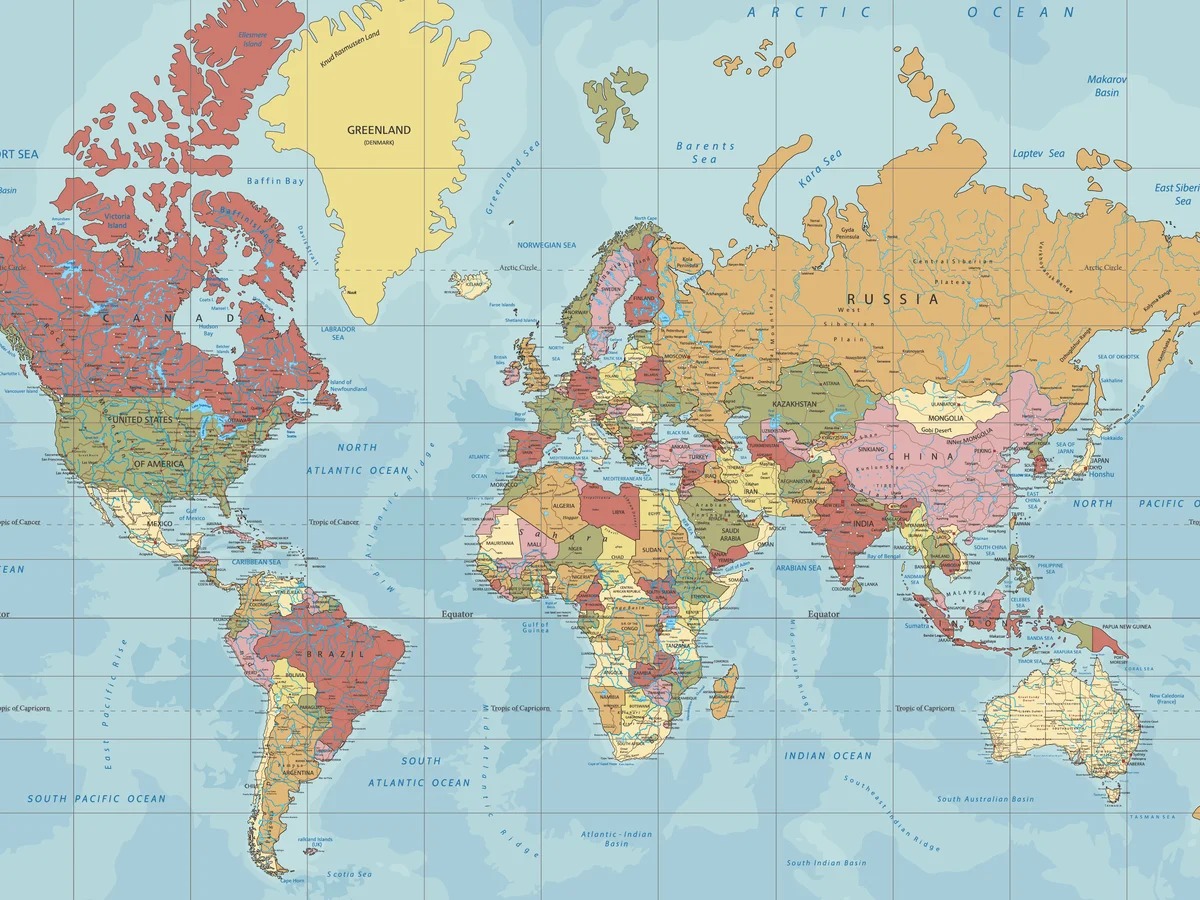
The African Union’s call to replace the Mercator projection with a more accurate map is more than a cartographic debate—it is a statement of politics, identity, and fairness.
According to theguardian.com, for centuries, Africa’s vast scale has been minimized on the world’s most popular maps, a distortion rooted in Europe’s colonial navigation. Correcting this image is not just about geography, but about restoring balance in how the world perceives Africa’s size, promise, and place..
By stretching the higher latitudes and squeezing the equatorial belt, the Mercator projection distorts the relative size of continents. Europe and North America loom vast, while Africa and South America shrink. Greenland often appears roughly the same size as Africa, when in reality the continent is 14 times larger. The impression is that the north is large and central, the south peripheral and marginal.
Cartographic distortion would be forgivable if it were confined to sailing charts. But for generations of policymakers – and of children – the world has been presented through a lens that flatters the powerful and diminishes the rest. The academic Mark Monmonier, in his book Rhumb Lines and Map Wars, counters that empires were driven by politics and economics more than classroom atlases – a point echoed by critics who say Mercator has become overrated as a tool of western imperialism. It is true that colonialism didn’t need maps to justify itself, but maps helped to naturalise its worldview.
READ: News: AU Pushes for Accurate World Maps to Correct Africa’s Undersized Depiction
There are also better alternatives to Mercator. The Equal Earth projection, introduced in 2018, gives a truer sense of area while retaining a visually intuitive layout. Earlier attempts, such as the Goode homolosine or the Peters projection, made similar efforts to redress the balance. None is perfect.
Representing a sphere on a flat plane requires compromise. But the point is not perfection; it is honesty. And honesty requires acknowledging distortion where it matters most.
It’s a long-running debate, but for many it was popularised by Aaron Sorkin’s West Wing TV drama. In a famous scene from 2001, a group of earnest cartographers explain to a White House press secretary how Mercator has misled generations into believing Greenland is the spatial equal of Africa.
The exchange plays for laughs. But it also delivers a serious truth. Start from the wrong map, and you risk ending with the wrong conclusions. That observation has a broader resonance. Leadership depends on an accurate starting point. Whether in business or politics, vision without truth is fantasy. The West Wing moment was seen as being about leadership. Great leaders, the thinking runs, succeeded not only by imagining the future but by demanding clarity about the present. And clarity begins with the facts, not the distortions of old prejudice – whatever the real-life occupant of the West Wing thinks.
The Mercator projection was born, undoubtedly, of European priorities in an age of empire. To continue using it as the default projection is surely to perpetuate those priorities. By contrast, adopting, say, Equal Earth is not only more geographically sound but emblematically important. It makes clear that Africa won’t be diminished in print when, in fact, it is vast in scale and promise.
Critics may scoff that changing maps is only symbolic. But symbols mould perception, and perception drives decisions. Draw Africa small and it is treated as small; draw it true and its scale and potential become harder to ignore. The African Union seems more right than wrong. It offers not pedantry, but leadership.
