
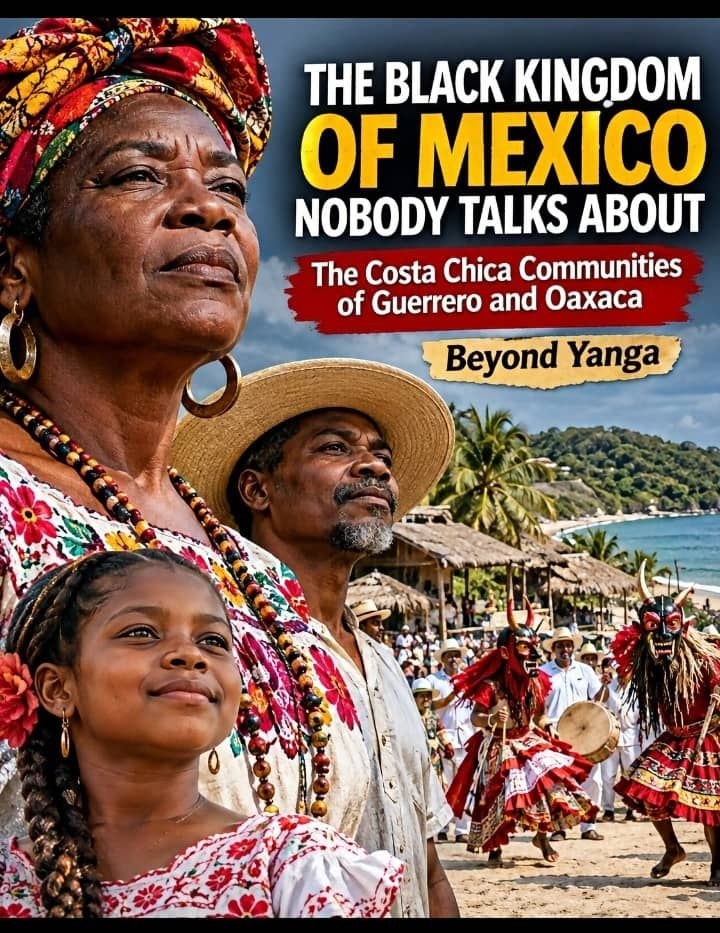
Did you know that Mexico has a historic Black population whose ancestors survived slavery, built communities, preserved African cultural traditions, and helped shape Mexican society — yet their history has remained largely invisible in mainstream historical narratives?
When people discuss the history of Africans in Mexico, one name often comes up: Gaspar Yanga, the African-born freedom fighter who led a rebellion against Spanish colonial rule and became associated with one of the earliest recognized free Black settlements in the Americas.
But there is another remarkable story beyond Yanga.
Along Mexico’s Pacific coastline, stretching across Guerrero and Oaxaca, lies Costa Chica, home to generations of Afro-Mexican communities whose African ancestry dates back to the colonial era.
These communities are living evidence that African history in the Americas did not end with the slave trade. It continued through survival, cultural preservation, resistance, and the creation of new identities.
1, HOW DID AFRICANS ARRIVE?
During Spanish colonial rule, Africans were forcibly transported across the Atlantic to New Spain. They were enslaved and made to work in agriculture, livestock production, mining, domestic service, and other sectors. Some Africans also arrived as free people, while others escaped slavery or gained freedom. Over generations, African descendants established families and communities alongside Indigenous and European populations.
2, THE COSTA CHICA
Costa Chica is not a separate country or an ancient Black kingdom with a single monarch. It is a historical and cultural region along Mexico’s Pacific coast. It includes Cuajinicuilapa, Ometepec, San Nicolás, Pinotepa Nacional, Santiago Tapextla, and other communities with longstanding Afro-Mexican populations.
3, CULTURAL TRADITIONS
Music, dance, oral traditions, celebrations, and community practices reflect centuries of cultural exchange. The region is associated with the chilena musical and dance tradition and the Danza de los Diablos (Dance of the Devils), an important expression of Afro-Mexican identity and cultural heritage.
4, A HISTORY OF RESISTANCE AND COMMUNITY BUILDING
The history of Costa Chica should not be reduced to slavery. African descendants also worked as ranchers, farmers, fishermen, traders, and community builders. Historical research documents African-descended populations in the region from the 16th century, and by the 18th and 19th centuries these communities were part of the region’s social and economic landscape.
5, WHY WERE THEY FORGOTTEN?
For generations, Mexico’s national identity was often presented through narratives emphasizing Indigenous and European heritage, while African contributions received far less attention. Afro-Mexicans experienced racial discrimination, social exclusion, and limited representation in education and public life. Their contributions were frequently minimized in popular historical accounts.
6, MEXICO FINALLY RECOGNIZED ITS AFRO-DESCENDANTS
In 2019, Mexico amended Article 2 of its Constitution to formally recognize Afro-Mexican peoples and communities as part of the country’s multicultural composition. The 2020 national census recorded approximately 2.58 million people who identified as Afro-Mexican or Afro-descendant, about 2% of the national population.
7, THEY ARE NOT FOREIGNERS
The Afro-Mexican communities of Costa Chica have roots in Mexico stretching back centuries. Their families have contributed to agriculture, livestock, music, traditions, and community life. They are part of the country’s historical and cultural foundation.
8, BEYOND YANGA
Gaspar Yanga’s story is important, but he should not be the beginning and end of African history in Mexico. The communities of Guerrero and Oaxaca remind us that African descendants established families, maintained cultural traditions, developed communities, and continued to fight for recognition.
The Black history of Mexico is much bigger than one freedom fighter, one settlement, or one historical event. It is the story of generations of people whose contributions helped shape a nation, even when history books failed to give them the recognition they deserved.
HISTORY QUESTION: If Mexico has millions of people who identify as Afro-Mexican, and communities in Guerrero and Oaxaca have preserved African-descended traditions for centuries, why do you think their history receives so little attention in mainstream discussions of African history?
Should Afro-Mexican history receive greater attention in schools around the world?
