
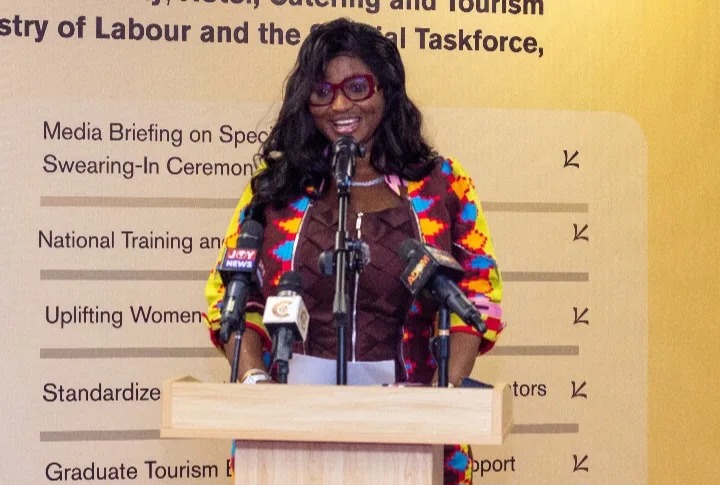
As part of efforts aimed at raising professional standards and supporting women’s participation in Ghana’s tourism sector, the Ghana Tourism Federation (GHATOF) and the Ghana Tourism Authority (GTA) launched a suite of national training and empowerment initiatives.
According to Herald Ghana, the initiatives were outlined during a swearing-in ceremony of news members alongside a media briefing on Thursday, 9 April 2026 at Accra City Hotel, where stakeholders emphasised the need for stronger collaboration to enhance the performance of the tourism and hospitality industry.
President of GHATOF, Seth Ocran, said the Federation is focused on improving efficiency and promoting the welfare of its members and stakeholders. “My vision is to lead this noble Federation toward greater efficiency, ensuring maximum welfare for our members and all stakeholders within the tourism and hospitality industry,” he said. He states that this would be achieved through strategic partnerships with key institutions, stronger corporate governance structures, and the development of robust systems to support industry growth.
According to him, tourism remains a key contributor to Ghana’s economy, accounting for about 5.7 percent of Gross Domestic Product (GDP). He added that ongoing interventions are expected to increase the sector’s contribution to 10 percent by 2030. “Tourism and hospitality contribute significantly to our GDP… we can increase the sector’s contribution from the current 5.7% to 10% by 2030,” Ocran stated. As part of the collaboration, GHATOF and GTA are rolling out the National Professional Training and Certification Programme, alongside the Uplifting Women in Tourism (UWIT) programme. The UWIT initiative is designed to support women who operate chop bars by improving their access to affordable finance, digital tools, reliable energy, and business recognition.
“The women who operate Ghana’s chop bars have never lacked talent, resilience, or ambition. What they have lacked is access to affordable finance, digital tools, reliable energy, and the recognition their enterprises deserve,” he said. In addition, the National Professional Training and Certification Policy Framework is expected to standardise skills development across the sector. The programme targets frontline workers, including those in hospitality, tour operations, and related services. “I want to speak directly to our frontline workers: this programme was designed with you in mind… certification must be accessible—not just aspirational,” Ocran added.
Chief Executive Officer of the Ghana Tourism Authority, Maame Efua Houadjeto, said the transformation of the tourism sector requires coordinated efforts between government, the private sector, and training institutions. “No single institution can transform the sector alone… but together, we can build a sector that is professional, competitive, and globally respected,” she said. She announced the introduction of the Graduate Tourism Employment and Mobility (GTEM) support programme, which will train and certify 200 graduates as professional tour guides.
“This program is not theory, it is direct intervention… we are going to train and certify 200 graduates as professional tour guides and deploy them into the tourism ecosystem,” Houadjeto explained.
The initiative will also provide mobility support to enable participants to operate effectively within hotels, tour companies, cultural sites, and events. “We are going beyond training… through a structured work and pay model, these young professionals will have access to vehicles… this is how we move from unemployment to enterprise,” she added. The GTEM programme will further extend support to small tourism businesses, particularly those facing operational constraints such as limited access to logistics and resources. “We know the reality… many good businesses in tourism are not failing because of lack of demand, but because of lack of support and operational capacity,” she noted.
As part of efforts to promote sustainability, the Ghana Tourism Authority is also partnering with financial institutions to support the adoption of clean energy solutions within the industry. “Because when businesses reduce operational cost, they become more stable, more competitive, and can deliver better value,” Houadjeto said. She stressed the need for improved standards and professionalism across the sector. “If Ghana is serious about becoming a leading tourism destination, then we must be serious about standards and professionalism,” she added. The newly sworn-in leadership of GHATOF has been tasked with supporting the implementation of these initiatives, promoting standards, and strengthening coordination among stakeholders within the tourism sector.
