
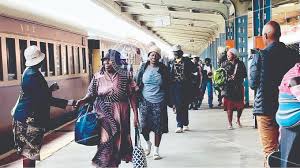
The National Railways of Zimbabwe (NRZ) has resumed passenger train services on the Bulawayo–Victoria Falls and Harare–Mutare routes, with operations restarting on Friday.
According to heraldonline, during this year’s Sanganai/Hlanganani World Tourism Expo, NRZ reintroduced its tourism train service — a cost-effective travel option offering scenic experiences for travellers.
This rail travel alternative exposes passengers to some of Zimbabwe’s iconic destinations and supports the growth of domestic tourism. The initiative, launched under NRZ’s Rail Leisure Division, forms part of a broader strategy to make domestic travel more affordable while showcasing the country’s natural beauty and historic landmarks.
Commenting on the development, NRZ spokesperson Mr Andrew Kunambura said the passenger train services had been suspended during the Covid-19 pandemic and were being reintroduced in response to public demand.
“We are simply reviving a service that was paused during the Covid-19 period. We used to operate these routes before, and we are now reintroducing passenger trains across all our routes, starting with Bulawayo–Victoria Falls and Harare–Mutare.
“During the time, we weren’t running passenger trains, there was an outcry from our loyal customers and we are responding to their concerns,” said Mr Kunambura.
NRZ has been working to improve its infrastructure, including rolling stock, to ensure passengers receive value for money. The state-owned rail operator first introduced commuter trains — commonly known as Freedom Trains — in Harare and Bulawayo in 2001, to cushion the public from rising transport costs.
The service was suspended in 2020 following the outbreak of Covid-19 but was reintroduced in 2021 through a partnership with the Zimbabwe United Passenger Company, which was struggling to cope with high commuter volumes.
Meanwhile, NRZ is pressing ahead with its recapitalisation plan, part of the Government’s broader efforts to modernise critical infrastructure and reposition the parastatal as a key driver of economic growth and regional trade integration.
For Zimbabwe’s economy, investment in NRZ carries wider implications. Improved rail efficiency will reduce the country’s over-reliance on road transport, which has contributed to the deterioration of highways.
Heavy trucks transporting goods have accelerated road damage, prompting the Government to allocate substantial funds for annual road rehabilitation.
By shifting bulk cargo back to rail, the Government will not only save on road maintenance costs but also improve highway safety by reducing accidents caused by overloaded vehicles.
At a regional level, a revitalised NRZ will position Zimbabwe as a strategic logistics hub in southern Africa. Rail connectivity with neighbouring countries such as South Africa, Zambia, and Mozambique will enhance cross-border trade by enabling seamless movement of goods.
Zimbabwe’s location along the North–South Corridor — a key regional trade route — means that an efficient rail system will attract transit cargo, boost revenue and strengthen regional economic integration.
Beyond economic benefits, the NRZ recapitalisation programme also promises gains for ordinary Zimbabweans.
The rehabilitation of rail infrastructure and procurement of new rolling stock will create thousands of jobs, both directly and indirectly.
With NRZ now under the Mutapa Investment Fund, experts say this development is central to achieving Vision 2030, which aims to transform Zimbabwe into an empowered upper-middle-income economy.
