
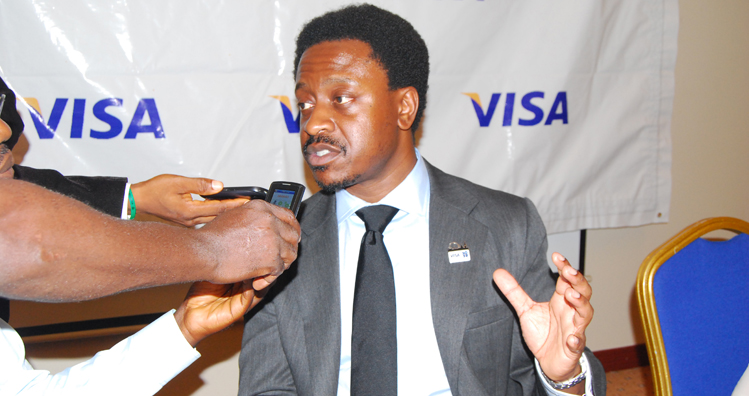
The Country Manager, Sub-Saharan Africa, Visa Incorporated, Mr. Ade Ashaye believes that as the appetite for production and services in the Nigerian economy grows, it will translate into broader integration across the continent and globally. He spoke to Obinna Chima. Excerpts:
How will you assess the cashless policy in Nigeria?
There has certainly been an increase in the number of locations that one can use one’s Visa card to transact and we are beginning to see the transaction volumes increasing steadily. In the areas where merchants and cardholders understand the benefits of electronic payments such as security, convenience and guaranteed payment, we see the fastest growth. There is still a significant opportunity for electronic payments to replace more of the cash payments in Nigeria and the cashless policy is a major factor in that effort.
We have observed that despite the increasing number of transactions through ATMs, Point of Sale (POS) transactions remain quite low. What is responsible for this?
Actually we have seen very good growth in the volume of POS transactions, but in specific areas. Infrastructure reliability has been an issue, but I believe a bigger issue is the fact that many merchants do not necessarily perceive or understand the benefits of electronic payments to their businesses. Where these benefits are well understood, the growth rates have been most significant.
So what future do you foresee for cashless banking in Nigeria?
As with many countries around the world, there is still a significant opportunity for electronic payments to replace more of the cash payments in Nigeria.
With the increasing threats of cybercrime globally, what do you think banks should do to guarantee customers’ transaction security and trust?
The 3D-Secure platform that powers Verified by Visa is an example of the sort of tools that help prevent fraud in the online environment. New enhancements to Verified by Visa now allow the issuer to prompt for additional validation only for the riskiest transaction, allowing for a streamlined checkout experience. But fraud prevention is everybody’s responsibility. Knowledge is key and educating customers on the basic steps they can take, to protect themselves (or the do’s and don’ts) will go a long way to protecting the industry. Some steps to prevent online fraud would include to keep current with your software and virus protection, create strong passwords, ignore e-mails from senders you don’t know, use your pop-up blocker and download files only from sites you know.
What would you say is the major challenge of e-payment in Nigeria?
The biggest challenge we face right now is education – educating merchants and consumers on the benefits of using electronic payments as well as trusting in the system over cash.
So, how is Visa bracing up for the competition in the payment space following the entrants of new players?
We have always welcomed competition and will continue to do so because it challenges us to innovate to continue to stay ahead. The global payment industry continues to undergo dynamic change. At the end of the day, consumers vote with their wallets, and we believe the speed, convenience and security of Visa are compelling differentiators for us. We believe Visa is well-positioned competitively thanks to our global brand, the broad set of Visa-branded payment alternatives and our proven track record of handling payment transactions securely and reliably through our payments processing network — VisaNet.
Our goal is continue to establish our presence in market to bring the benefits of electronic payment to even more Nigerians. We are also continually focused on enhancing our products, systems and services to bring the benefits of electronic payments to the market. I’ll only really be satisfied when Nigerians have access to the same products and services that are available in other, more advanced markets. Some immediate plans include growing our local office. We are very much committed to investing in local talent under the guidance of our expert Visa staff who bring with them their international expertise
So what is your firm’s commitment to financial literacy?
Visa believes the most important financial tool is knowledge. That is why for over a decade Visa has been developing financial literacy programs that teach individuals how to spend, save and budget responsibly. Supporting financial literacy is both good for our business and the right thing to do. Visa’s global financial literacy initiative is localised across more than 30 countries and in 2009, Visa pledged to reach 20 million people through financial literacy education by 2013—a goal surpassed one year ahead of schedule in May 2012. We’re now approaching 30 million people that have been reached by our by our financial literacy initiative. As a global payment technology company, we see one of the most valuable contributions we can make as helping to bring more people into the formal financial system. We do so by creating pathways to financial inclusion for the financially underserved through our products, services, technology, and payments expertise; financial literacy tools and resources; and our strategic partnerships.
We believe access to financial services is essential for progress. Financial inclusion moves people from being underserved and isolated members of our economic system to thriving and contributing participants. Improving access to financial services and electronic payments is a critical building block to help more people improve their lives and lift themselves out of poverty. Given the appetite to increase financial service penetration coupled with the government and CBN focus on supporting the advancement of financial inclusion, Nigeria has been identified as a key strategic country for many private sector companies and organizations that are committed to advancing financial inclusion.
What areas of growth and opportunities for Nigeria were identified by Visa’s Africa Integration Index?
Nigeria, which recently overtook South Africa to become the largest economy in Africa, had a score of 40.5 at the end of 2013 on the Visa Africa Integration Index improving from 37.7 at the start of 2011. At the end of 2012, the Index level was virtually the same at 40.6. Nigeria will benefit enormously from greater integration, as its growing market matures and modernises, and the demand for capital and a diversity of trade partners rises to address the needs of increasing industrialisation, a rising appetite for production and services and growing sophistication in lifestyles Nigeria has made significant strides in regional integration efforts where its score increased from 30.8 to 34.8 during the three year period ending 2013. This is likely to translate into broader integration across the continent and further afield in global integration.
What are your plans to continue growing debit usage and acceptance in Nigeria?
Our goal is to replace costly, inefficient forms of payment, for example cash and cheques, with more secure, convenient and reliable ways to pay. Key to that strategy is offering consumers choices — credit, debit and prepaid products. Debit is a key tool for migrating consumer spending made with cash and checks to electronic forms of payment. Visa is focused on growing debit in Nigeria by giving consumers more places to use their debit cards — especially in everyday spend categories, helping merchants understand the value of debit acceptance — access to millions of consumers worldwide, guaranteed payment for goods and services, and an enhanced point-of-sale experience for customers over cash and checks, improving consumer awareness of the benefits of debit — convenience, security, money management, and control. In addition, by encouraging consumers to use their debit cards at the point of sale instead of cash, protecting and growing brand relationships and expanding our benchmarking capabilities, providing financial institutions with greater insight into portfolio performance and analytical tools to help them grow their debit business.
