
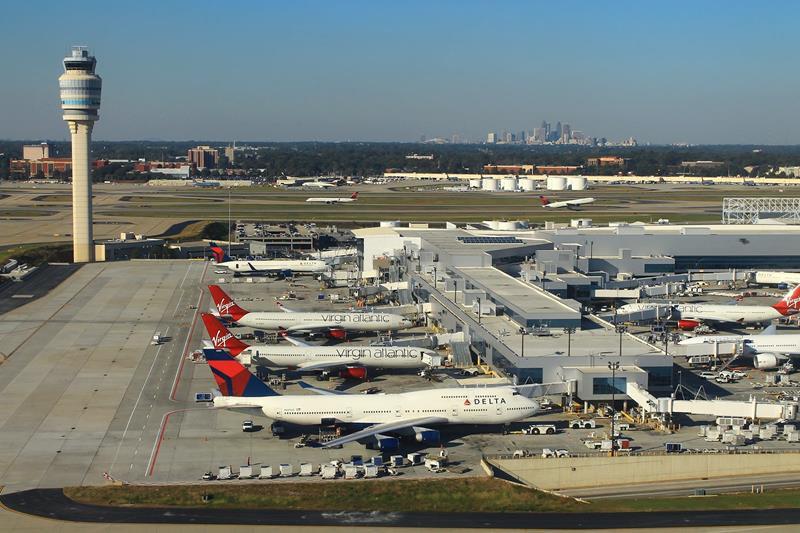
On any given day, more than 20,000 planes are flying in the sky at the same time, according to FlightRadar24.
Major airports like London Heathrow and New York JFK handle a large share of this air traffic, making them some of the busiest and most important hubs in the world.
According to aviationa2z, Europe’s bustling airspace, especially between major hubs like Paris Charles de Gaulle (CDG) of Air France (AF) and Frankfurt Airport (FRA) of Lufthansa (LH), remains among the world’s busiest. Notably, the corridor between London (LHR) and Dublin (DUB) supports Europe’s most flown international route.
Busiest Airspace in the World
The world’s most crowded airspaces are not only defined by the sheer number of flights but also the density of jet streams and intersecting routes, especially in metropolitan clusters.
1 Western Europe: Dense Routes and Congested Hubs
Major zones stretch from southern England, Germany, and the Low Countries through France, Italy, and Spain.
London-Heathrow (LHR), Paris-CDG (CDG), Frankfurt (FRA), and Amsterdam Schiphol (AMS) experience near-continuous airborne queues.
The London (LHR)-Dublin (DUB) flight path sees an annual passenger volume exceeding 4.5 million, underlining its status as Europe’s busiest international connection.
Popular intra-European air routes include Paris-Nice (NCE), Madrid-Barcelona (BCN), Rome-Catania (CTA), and Paris-Toulouse (TLS).
Aircraft frequently reroute over the southeastern tip of Turkey to avoid airspace over Syria and Iraq, further tightening regional congestion.
North America: Clustered Mega Airports
2 New York City–Philadelphia–Washington D.C.
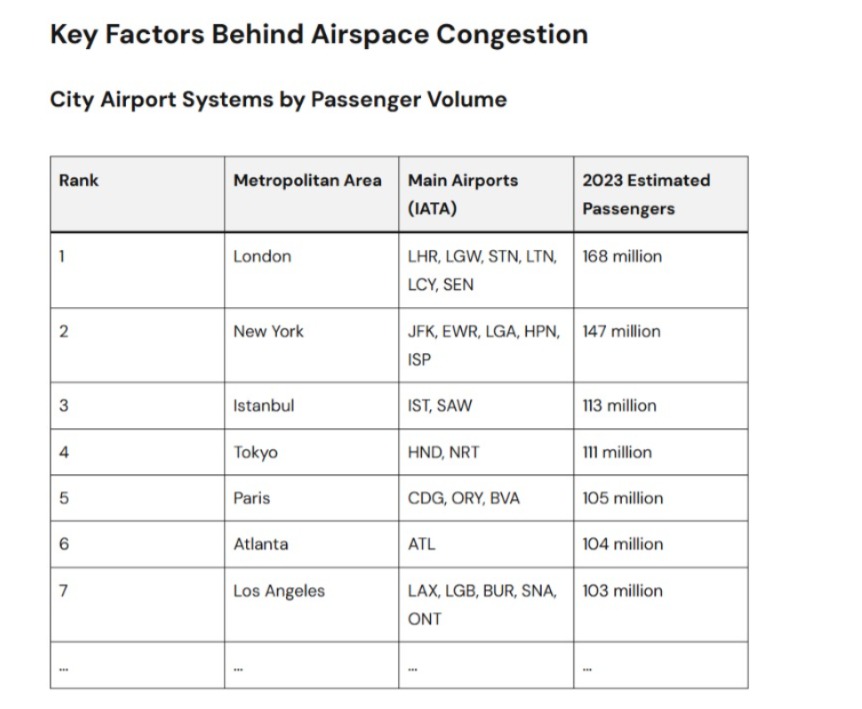
New York City boasts six airports, including John F. Kennedy International (JFK), Newark Liberty (EWR), and LaGuardia (LGA), with a cumulative throughput surpassing 147 million passengers annually.
The corridor also includes Philadelphia International (PHL), Ronald Reagan Washington National (DCA), and Dulles International (IAD), creating one of the densest traffic pockets globally.
3 Los Angeles and the San Francisco Bay
LAX (Los Angeles International) sees over 74 million passengers per year, supporting both urban and transpacific flows.
The Southern California airspace integrates LAX, Long Beach (LGB), Burbank (BUR), John Wayne (SNA), and Ontario (ONT), collectively processing over 100 million annual passengers.
Daily, over 120 flights link LAX and San Francisco International (SFO), reflecting significant intercity demand.
4 Chicago and South Florida
Chicago’s O’Hare (ORD), Midway (MDW), and Rockford (RFD) airports serve more than 96 million passengers, reinforcing Chicago’s standing as a Midwest nexus.
South Florida’s Miami (MIA), Fort Lauderdale (FLL), and Palm Beach (PBI) airports contribute to the region’s skyway saturation, each ranking among the United States’ most trafficked.
Asia and the Middle East: Rapid Growth and Airspace Pressure
5 Tokyo and East Asia
Tokyo’s Haneda (HND) and Narita (NRT) airports create the world’s third-busiest city airspace system, handling over 111 million yearly passengers.
East Asian corridors—Shanghai Pudong (PVG), Beijing Capital (PEK), and Hong Kong International (HKG)—rank among the top ten globally, with Shanghai alone serving nearly 97 million.
6 The Persian Gulf
Dubai International (DXB), Abu Dhabi International (AUH), and Doha Hamad (DOH) airports anchor one of the world’s fastest-growing airspace zones, now handling tens of millions of international travelers annually.
The region’s aviation rise is notable, with Dubai (DXB) leading in total international passenger volume.
