
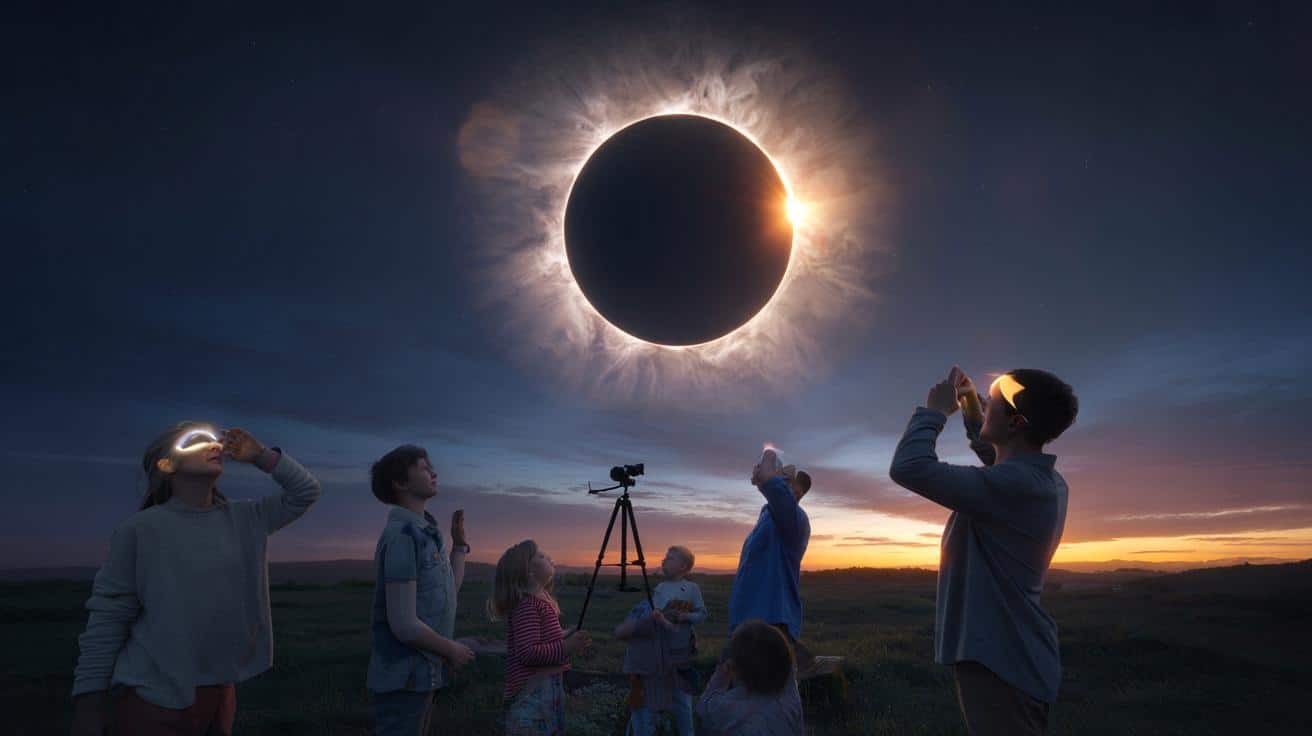
Skywatchers and space enthusiasts are preparing for a historic celestial event as the longest total solar eclipse of the century is set to occur on August 2, 2027, with totality expected to last up to six minutes and 43 seconds in some areas along its path.
Accordign to india.com, during the rare alignment, the Moon will move directly between the Earth and the Sun, plunging sections of the world into an extended twilight that far exceeds the duration of most eclipses. In certain locations along the path of totality, observers are projected to experience darkness lasting approximately six minutes and 23 seconds — an extraordinary window for scientific observation and public viewing alike.
Astronomers note that the unusually long period of totality will offer a prime opportunity to study the Sun’s corona and atmospheric phenomena, while also drawing global attention from travellers eager to witness one of the most dramatic astronomical spectacles of the modern era.
As the sun slowly dips below the horizon, an eerie hush falls over the crowd. The streetlights flicker on, bathing the scene in an otherworldly glow. In this rare moment, day turns to night, and the longest solar eclipse of the century is about to unfold.
For astronomy enthusiasts and casual observers alike, the impending celestial event has generated a palpable sense of excitement. After years of anticipation, the date for this remarkable phenomenon has finally been set, promising a spectacle that will captivate the world.
A Rare Celestial Alignment
On July 2, 2019, a total solar eclipse will sweep across South America, offering a once-in-a-lifetime opportunity to witness the moon’s complete coverage of the sun. This event, known as the “Great South American Eclipse,” will be the longest solar eclipse of the 21st century, lasting up to 2 minutes and 40 seconds.
The path of totality, where the moon completely blocks the sun’s light, will stretch across parts of Chile and Argentina, providing the best vantage points for observers. Cities like La Serena, Coquimbo, and San Juan in Chile, as well as Mendoza and San Juan in Argentina, are expected to be prime viewing locations.
Astronomers and scientists are eagerly anticipating this event, as it will provide invaluable data and insights into the sun’s corona, the outermost layer of the solar atmosphere. The extended duration of the eclipse will allow researchers to study the intricate details of this mysterious region, potentially leading to a better understanding of solar activity and its impact on Earth.
A Celestial Spectacle
During a total solar eclipse, the moon’s shadow falls upon the Earth, creating a breathtaking visual display. As the moon gradually covers the sun, the sky will gradually darken, and the temperature may drop noticeably. The sun’s corona, normally obscured by the sun’s bright light, will become visible, shimmering and dancing around the moon’s silhouette.
This celestial ballet will be accompanied by a unique natural phenomenon known as “Bailey’s Beads.” As the moon’s edge passes over the sun’s surface, small beads of light will appear along the moon’s limb, creating a mesmerizing effect.
For those fortunate enough to witness this event in person, the experience will be nothing short of awe-inspiring. The transformation from day to night, the eerie silence, and the ethereal glow of the sun’s corona will leave a lasting impression on all who behold it.
Preparing for the Eclipse
With the date of the eclipse now firmly set, astronomers and local authorities are already making preparations to accommodate the influx of visitors. Hotels, transportation, and infrastructure in the affected regions are being carefully coordinated to ensure a smooth and safe viewing experience.
Specialized eclipse glasses and other protective equipment are also in high demand, as safety is paramount during the event. Experts caution against looking directly at the sun, even during the brief moments of totality, as the sun’s intense rays can cause permanent eye damage.
For those unable to travel to the path of totality, various live-streaming and online platforms will offer the opportunity to witness the eclipse from the comfort of their homes. However, nothing can quite compare to the visceral experience of being present in the moment, surrounded by the wonder and mystery of this celestial phenomenon.
The Science Behind the Eclipse
The upcoming solar eclipse is a testament to the precision and predictability of our solar system. The moon’s orbit around the Earth, combined with the Earth’s orbit around the sun, creates a delicate dance that aligns the three bodies in a perfect configuration, allowing the moon to temporarily block the sun’s light.
This intricate choreography is the result of years of careful observation and calculation by astronomers. By understanding the orbital patterns and the relative sizes and distances of the sun, moon, and Earth, scientists can pinpoint the exact dates and locations of solar eclipses with remarkable accuracy.
Beyond the sheer spectacle, the data collected during the eclipse will be invaluable for advancing our scientific understanding of the sun and its impact on our planet. Researchers will closely monitor the sun’s corona, studying its structure, temperature, and magnetic fields, which could lead to new insights into solar activity and its potential effects on Earth’s climate and technology.
A Global Phenomenon
The upcoming solar eclipse is not just a regional event; it has captured the attention of people around the world. As news of the eclipse’s official date has spread, a sense of global anticipation has begun to build.
For some, the eclipse represents a unique opportunity to experience the awe-inspiring beauty of our universe. For others, it is a chance to engage with the fascinating science behind these celestial events. Regardless of their motivations, people from all walks of life are eager to witness this rare and remarkable phenomenon.
In the lead-up to the eclipse, educational institutions, astronomical societies, and local communities are organizing viewing parties, lectures, and outreach programs to help the public better understand and appreciate the significance of this event. The hope is that by sharing this experience, more people will develop a deeper connection with the natural world and the mysteries of the cosmos.
A Moment of Reflection
As the world turns its gaze skyward on July 2, 2019, the solar eclipse will serve as a powerful reminder of our place in the grand cosmic dance. In a fleeting moment, the day will turn to night, and the boundless expanse of the universe will be laid bare for all to see.
This celestial event is not just a scientific curiosity; it is a profound reminder of the interconnectedness of all things, a testament to the wonders of our universe, and a humbling acknowledgment of our own insignificance in the grand scheme of the cosmos.
For those who witness this eclipse, it will be a moment of awe, contemplation, and perhaps even a deeper appreciation for the incredible complexity and beauty of the natural world. As the moon’s shadow sweeps across the Earth, it will serve as a poignant reminder that even in the face of the vast and the unknown, we are all part of something greater, something that transcends the boundaries of time and space.
