
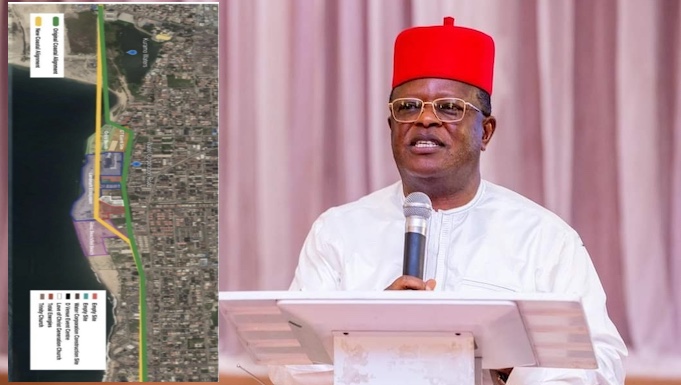
Nigeria’s Minister of Works, Dave Umahi, has announced that the federal government will revert to the original gazetted alignment for the Lagos-Calabar coastal highway, eliminating the proposed new route from kilometers 16 to 25 of the 47-kilometer highway.
According to arise.tv, Umahi disclosed this in Lagos at the 3rd stakeholders meeting of the coastal highway project on Thursday.
During a two-hour session that included presentations and a question and answer segment, Umahi invited representatives of telecommunications companies affected by the ongoing project, residents of Okun Ajah community, as well as other stakeholders, to make a case for why the new alignment should be altered.
Highlighting the concerns of MTN, 2Africa and other telecoms companies was the Group CEO of Machine and Equipment Consulting of Africa.
“We have three critical infrastructure that are located on one spot. One is the 2Africa submarine cable that cuts across 33 countries connecting about three billion people. That cable landed at Mopo and where it landed, the West African cable systems (WACS) had already been located there about 17 years ago.
“We have a mega IPP which is to provide power to the 2Africa cable and the WACS cable. The power plant is a 50 megawatt power plant expected to support this infrastructure.
“The (new) corridor is passing right on the submarine cable and the other side is on the IPP. You cannot have the submarine cables without power. They will not function. The submarine cable is a critical national security infrastructure. If it is affected, everybody will be affected,” he said.
He made reference to the recent subsea cable diruptions that caused internet outages in several countries across Africa.
“Two months ago, there was a challenge as far as Cote d’Ivoire but a significant part of Africa was blanked out. Our appeal today is in view of the fact that this is not just a private project, it’s a national project, it’s the internet gateway to the nation and it’s linked to national security.
