
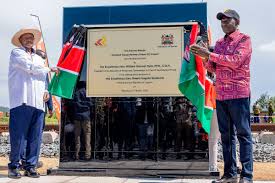
On Saturday, March 21, 2026, President William Ruto and Ugandan President Yoweri Museveni officially launched the construction of the Kisumu–Malaba Standard Gauge Railway (SGR), a critical extension designed to complete the long-stalled regional rail link.
According to The Nation, the two leaders said the railway is expected to reduce heavy reliance on roads, and subsequently lower the cost of doing business. They said the SGR will bring economic revitalisation to the region that will be felt for generations to come.
The two heads of state broke ground in Kibos, Kisumu for the 107-kilometre Kisumu–Malaba section of the SGR. This section will form a vital connection to the Malaba–Kampala line. President Ruto said the railway line will also serve partner states in the region; Rwanda, Burundi, South Sudan, the Democratic Republic of Congo, and the Central African Republic. The railway line is aimed at enhancing, regional integration. Dr Ruto said currently businesses continue to grapple with high logistics costs that undermine competitiveness. He said transport and related costs account for between 30 per cent and 40 per cent of the final value of goods.
“On average, cargo takes 80 hours to move from Mombasa to Malaba, and more than 100 hours to reach Kampala. We can’t build prosperity on inefficiency. That is why we must invest in efficient transport,” he said. “Over the past eight years, the SGR has transported more than 15 million passengers and over 45 million tonnes of freight. It has reduced transport costs, improved efficiency, and contributed significantly to the growth of our economy,” he said.
President Ruto said with the expansion of the SGR, freight costs are projected to decline by at least 40 per cent per tonne per kilometre, while transit times for freight will reduce by nearly 30 per cent. Dr Ruto said the extension of the railway will fulfil the aspirations of former Prime Minister Raila Odinga. “I remember when Raila was appointed AU Representative for Infrastructure; this was one of his proposals. I am confident that wherever he is, he is proud of this moment—that what he envisioned is now unfolding here in Kisumu. It is not just a railway line but a logistics hub, a commercial lifeline for our people. This was never ‘a railway to nowhere’; it was a railway to prosperity and transformation,” he said.
For his part, President Museveni said the amount of cargo that will be transported by rail will increase, easing pressure on roads. “Our plan is to transfer all heavy cargo to the railway, to reduce road maintenance costs and accidents. We also want to transfer all petroleum products to the pipeline. Railway transport, combined with water transport, eases pressure on the roads,” he said. President Museveni said that for Africa to remain competitive, countries must produce high-quality goods at lower costs. This, he said, can be achieved by reducing production costs such as transport, energy, and finance.
“This high cost of production is what has made Africa import-oriented,” said Mr Museveni. Orange Democratic Movement (ODM) leader Oburu Oginga said the SGR project was conceived during the Grand Coalition Government but implemented during President Ruto’s tenure. “When the past regime tried to push for its extension, the explanation given then was that the project was not viable. I am happy that President Ruto has found ways of financing the project. This shows commitment to developing infrastructure,” said Dr Oginga. Dr Oginga urged President Museveni to designate Lake Victoria as a “common user facility” to transform the shared waters into a seamless corridor for trade, maritime safety, and regional integration.
“I appeal to you, Mr Museveni, to allow Lake Victoria to be a common user facility so that we manage the security of the lake jointly without harassment from either side. We want it to be the way it was during the time of our forefathers, without conflict,” he said. In 2014, Phase 1A of the SGR was launched, stretching 472 kilometres from Mombasa to Nairobi. This was later extended inland to Suswa in Narok, covering an additional 120 kilometres. Two days ago, the President launched the extension of the SGR from Narok to Kisumu, a distance of 264km, forming part of Phase 2B of the railway network. That line will connect Nairobi’s industrial corridor to the agricultural heartlands of Narok, Bomet, Kericho, and Nyamira, and ultimately Kisumu
