
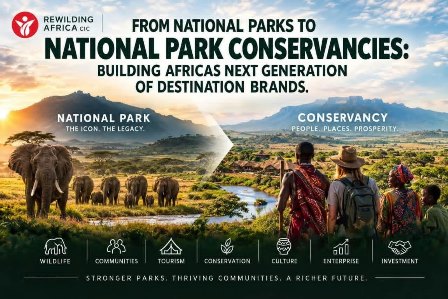
Rewilding Africa CIC, a UK-registered Community Interest Company, is intensifying its campaign to place communities at the centre of Africa’s conservation future. The organisation is building a continent-wide network of National Park Conservancies with one clear goal: to turn the lands around every national park into thriving, productive, and wildlife-rich economies where people and nature prosper together.
The premise behind the model is simple but urgent. National parks do not exist in isolation. Beyond their borders are communities, farms, traditional institutions, businesses, and wildlife corridors that ultimately determine whether conservation succeeds or fails. For decades, the fragmented parcels around parks have operated independently, weakening environmental, social and economic outcomes. Rewilding Africa CIC proposes to bring them together under a single National Park Conservancy Trust, creating the economies of scale and coordinated land management needed for long-term impact.
Through four core functions, the group is moving from idea to action. In Advocacy, it works to shift policy and practice toward community-led conservation and to build support among governments, park authorities, NGOs, investors, tourism bodies and the private sector. In Marketing, it develops National Park Conservancy destinations and brands that can attract visitors, investment and partnerships. In Planning, it helps stakeholders move from shared vision to practical roadmap through natural resource audits, community planning, land-use mapping and governance structuring. In Development, it mobilises the finance, enterprises and partnerships required to turn plans into functioning landscapes. This work follows an 8-step Phase 2 program that includes audits, zoning, social impact investment, rewilding, restoration and ongoing business development.
The ambition is captured in one line that now guides the movement: a thriving National Park Conservancy around every national park in Africa. Founder James Arnott describes the approach as applying destination-building principles to conservation, with vision, brand, land-use planning, stakeholder engagement and investment treated as equal pillars. The aim is coexistence, not fences that leave communities on the outside looking in.
The model draws strength from proven examples across the continent. In Kenya, 24 community conservancies in the Maasai Mara sustain the wildebeest migration and have supported the recovery of lion populations, with communities earning millions annually from tourism. In Namibia, 86 community conservancies cover about a fifth of the country and have helped triple the elephant population to 24,000 in 20 years. In Zambia, the Simalaha Community Conservancy shows how the rewilding of 2,145 animals can directly support livelihoods and strengthen commitment to conservation. These cases suggest that when communities hold tenure and benefit rights, both biodiversity and human well-being improve.
From a scholarly perspective, the National Park Conservancy represents more than another protected area. It functions as a boundary institution that mediates between statutory protection inside the park and the multiple land uses outside. By consolidating fragmented lands, it internalises externalities and aligns incentives so that community development, tourism revenue and ecological restoration become joint outputs of the same landscape.
It also reframes conservation as destination economics. The decision to begin with a Destination Brand Launch treats the landscape as a product with a story. This opens the door to blended capital, including social impact investment, concession leases and tourism enterprise, at a time when Africa’s conservation funding gap cannot be closed by aid alone.
Markets scale and brands travel, and when the brand is co-owned by communities and traditional leadership, legitimacy increases and costs fall.
Critically, the model embraces what can be called “rewilding with people.” Rather than removing communities from the landscape, the eight-step process embeds them from the start through comprehensive planning, enterprise development and governance. The approach mirrors successful efforts in Uganda’s Kibale landscape, where local employment in restoration created jobs while recovering biodiversity. In this way, ecological restoration is coupled with livelihood restoration, responding directly to the UN Decade of Restoration’s call for win-win outcomes.
For policy and research, three priorities emerge. Governments should create clear legal pathways for Conservancy Trusts to hold leases, enter contracts and distribute benefits transparently. Success must be measured beyond biodiversity alone, tracking natural capital, social capital and financial capital together. And Rewilding Africa CIC can serve as a platform for comparative learning, codifying the 8-step process for application from West Africa’s forest parks to Southern Africa’s savannas.
The challenge is enormous, but so is the opportunity. Rewilding Africa CIC is calling on governments, communities, NGOs, tourism businesses, investors, researchers and individuals to take part. Roles include partnering to design a Conservancy, funding a pilot landscape, supporting a community enterprise, and investing in conservation that pays back to both people and nature.
