

The Government of Kenya places a lot of emphasis on the improvement of the tourism sector in the country. Towards this end, the Kenya National Bureau of Statistics in collaboration with other stakeholders in the tourism sector continues to undertake a series of inbound and outbound expenditure surveys aimed at updating tourism statistics in the country.
Availability of quality statistics will not only help in determining the sector’s contribution to the economy but will also guide policy makers in taking relevant policy interventions to further improve the tourism industry.
The inbound and outbound expenditure surveys being undertaken in the country to provide key input for
estimating international tourism receipts used in compiling National Accounts (NA), Balance of Payments (BOP) statistics and key input for compilation of Tourism Satellite Account (TSA).
This report presents the findings of inbound and outbound tourism expenditure surveys carried out in
December 2024 and June 2025. This report provides a key steppingstone towards the establishment of a
proper System of Tourism Statistics (STS) in the country, that will in return enable the compilation of quality tourism statistics.
The STS will contain data necessary for measuring the demand and supply side of the tourism sector in the country. Further, this will go a long way in providing a framework for the improvement of methods used in estimating the contribution of the tourism sector to the Kenyan economy, hence, enabling formulation of appropriate policies for the tourism sector by the national and county governments.
The 2024/2025 Inbound and Outbound Tourism Expenditure Surveys provide critical insights into the
dynamics of international tourism in Kenya, marking a significantstep towards establishing a robust Tourism Satellite Account. The findings confirm tourism’s vital role as a source of foreign exchange and economic stimulation, while also highlighting key patterns in visitor behaviour and expenditure.
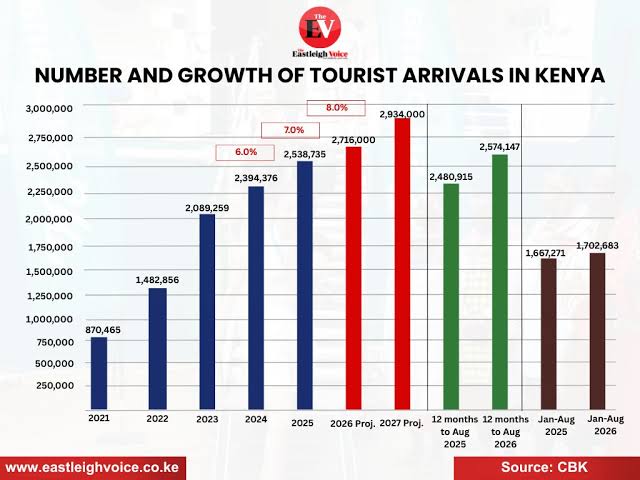
The data reveals a resilient and growing inbound sector, with a strong recovery in tourist arrivals.
Key source markets include the East African Community, North America and Europe. Inbound tourists are
predominantly middle-aged, highly educated professionals who primarily visit for holiday/leisure and
business purposes. A significant finding is the clear distinction in expenditure patterns.
The surveys successfully identified seasonal variations, demographic profiles, preferred activities, and spending habits across different items such as accommodation, transport, shopping and food. The high likelihood of both inbound and outbound tourists to repeat their travel and recommend Kenya as a destination indicates strong satisfaction and positive destination perception.
Outbound tourism by Kenyan residents is also significant, with major destinations being Tanzania, Uganda, the United Arab Emirates and the United States of America. The primary purpose for travel is business, followed by holiday and visiting friends and relatives. Similar to inbound trends, outbound tourists on package tours spend more.
However, the reliance on cash transactions by a majority of tourists and the underutilization of digital payment platforms point to areas for financial integration improvement. The successful execution of these surveys demonstrates the feasibility and importance of sustained, high-frequency data collection to fill the historical gaps in tourism statistics, as originally identified in the 2002 TSA feasibility study.
