
The 2026 ACI World Airport Traffic Dataset was released in July, revealing which were the top 20 cargo airports in 2025 and considering the dynamics behind the results.
According to aircargonews.net, data for 2025 indicates that total global air cargo volumes increased by 3.3% over 2024 volumes, and by 7.4% compared 2019, to 131m tonnes.
Earlier in the year, when it published preliminary data for 2025, ACI World described the context for the results as a “resilient but fragile global economy”.
Global GDP grew by around 3–3.2% in 2025, above expectations but below historical norms, with ongoing risks from trade tensions, protectionism and policy uncertainty affecting aviation demand while geopolitics reshaped traffic flows.
Capacity and slot constraints further complicated the picture.
However: “Air cargo volumes stabilised near record levels, supported by e-commerce and faster, restructured global supply chains,” the association said, noting lower fuel prices, easing inflation, international-led recovery and China’s reopening as more positive influences on aviation as a whole, including freight.”
ACI World observes: “Several of the broader economic and operating conditions that influenced airport [passenger] traffic in 2025 also affected air cargo, though to different degrees.
“Global cargo reached a record 131.2m tonnes in 2025, up 3.3%, supported by cross-border e-commerce, high-value and time-sensitive shipments, and changing supply chains. International freight was particularly strong, increasing 4.2%, while domestic freight declined 1.8%.
“Geopolitical tensions and disruptions to maritime and air routes have had a more complex effect. They can increase costs and disrupt capacity, but they can also strengthen demand for air cargo when shippers need faster or more reliable alternatives. E-commerce and supply-chain diversification therefore remained important supports to the market.”
As has been the case in previous years, airfreight traffic was more concentrated amongst the main airports; at 53.1m tonnes, combined air cargo volumes at the top 20 airports represented close to 41% of global air cargo traffic in 2025.
Hong Kong tops the charts
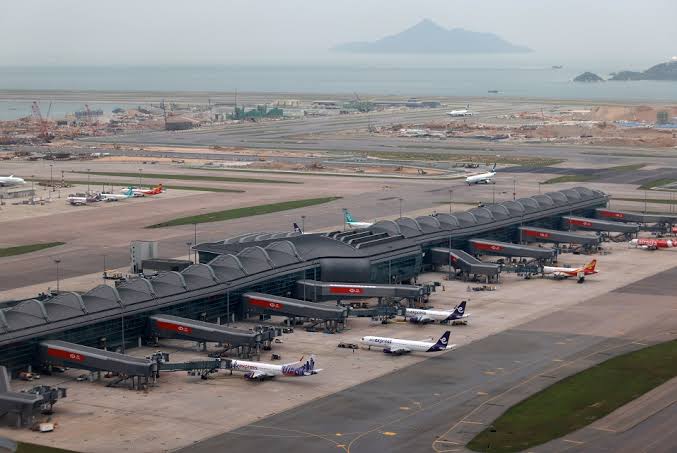
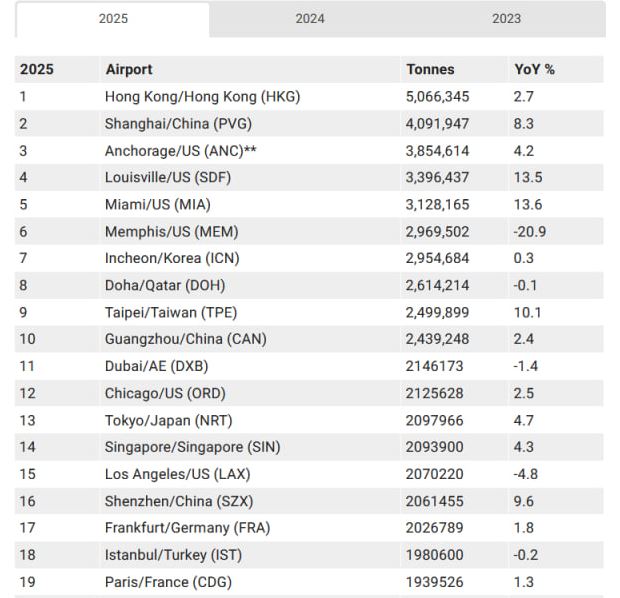
Hong Kong International Airport (HKIA; 5.1m tonnes, up 2.7% year on year) and Shanghai Pudong (4.1m tonnes, up 8.3%) retained first and second positions respectively.
A sad incident occurred in October last year when a cargo aircraft flying into Hong Kong from Dubai veered off the runway on landing, with fatal consequences for two airport staff members whose vehicle was knocked into the sea by the Boeing 747 freighter conversion.
Top 20 cargo airports
More positively, Hong Kong’s Air-Land Fresh Lane was launched in September 2025, creating a dedicated channel for importing chilled aquatic products, live seafood and fruits from overseas to the Greater Bay Area through HKIA and over the Hong Kong-Zhuhai-Macao Bridge.
Live and chilled goods can be delivered to Zhuhai for Mainland’s customs clearance and enter the GBA in as quickly as three hours after they arrive at Hong Kong by air, a statement said.
New flights last year included Hong Kong Air Cargo services to Glasgow Prestwick and One Air flights from East Midlands to the Asia-Pacific gateway via Liège, as well as an expanded schedule from Dubai-based Etihad Cargo.
This year, Air China Cargo and Ethiopian Airlines, too, added freighter flights to Glasgow Prestwick, while Cathay Pacific-owned Air Hong Kong has leased an Airbus A330P2F converted freighter to expand its regional operations. (Cathay Pacific itself placed a firm order for two A350Fs in May.)
At Shanghai Pudong, last year brought the relaunch of China Cargo Airlines’ Paris–Shanghai freighter service as well as China Eastern’s Buenos Aires flights. MyFreighter also initiated flights from the Chinese city to destinations including Amsterdam and Tashkent.
This year, Pudong Air Cargo Terminal Co Ltd (PACTL) recently relocated and upgraded its Cross-Border E-Commerce Handling Center at the PACTL West Terminal.
The handling area there has been expanded to approximately 4,170 sq m, an increase of 40%; daily handling capacity has doubled.
“With expanded space, upgraded equipment and enhanced digital capabilities, the centre is now better equipped to support efficient and reliable cross-border e-commerce operations,” PACTL says.
Alaska expansion
Across the Pacific, Ted Stevens Anchorage International rose from fourth to third place in the ACI World rankings on the back of a 4.2% rise in volumes to 3.9m tonnes.
ACI World notes that while the standard ACI definition of air cargo generally excludes transit freight in order to provide a consistent basis for comparison across airports, Anchorage is a specific exception and has reported its total cargo, including transit freight, since the association’s database was established back in the early 1990s.
“Approximately 70-80% of [Anchorage’s] volume is transit freight, reflecting the airport’s unique role as a technical and logistics stop between Asia and North America,” ACI World acknowledges.
Alaska International Airport System (AIAS) director Angie Spear says transit freight represents an important distinction when comparing Anchorage with other airports in the ACI World ranking.
She explains: “Unlike airports where most cargo originates or terminates in the local market, a significant portion of the cargo moving through Anchorage continues onward to destinations around the world.
“Freight may remain aboard the aircraft during a technical stop or transfer between aircraft before continuing to its final destination.
“Anchorage is not simply serving a local cargo market; it functions as an international crossroads where global supply chains connect mid-journey,” she emphasises.
In fourth and fifth place, Louisville (up from fifth position with 3.4m tonnes handled) and Miami (up from seventh place with 3.1m tonnes) both reported year-on-year growth of over 13% in their volumes, the strongest among the top five.
Louisville, where UPS has its global hub, set another record for its busiest year for cargo operations and beat its 2019 total by 21.7%.
Miami’s throughput, meanwhile, was an impressive 49.5% higher than in 2019; following six years of record-breaking growth, the airport now claims the title of busiest US airport for international freight.
On the other hand, Memphis International Airport (the global hub for FedEx) posted a sharp drop in volumes, with cargo down by 20.9% compared to the 2024 figure at just under 3m tonnes.
That volume is also 31.3% below the Tennessee airport’s 2019 total.
UPS’s facility at Louisville has overtaken FedEx in Memphis to become the world’s busiest express air cargo hub – although FedEx still serves more airports nonstop than any other hub in the world, according to the Global Cargo Hub Review by the Chaddick Institute for Metropolitan Development at DePaul University in Chicago.
Noting the “increasing operational complexity” amid which airports must perform, ACI World director general Justin Erbacci says: “These hubs keep people and goods moving, supporting global trade, tourism and economic growth in their communities and regions.
“To help keep pace with rising demand, governments must prioritise sustained investment in airports and the broader aviation ecosystem.”
Investment plans
For airports, investment on the freight side of the business can include cargo terminals and warehouses, freighter stands, automated handling and sorting, digital cargo processing systems, customs and screening facilities, improved landside access, and specialised cold chain facilities.
According to ACI World: “Governments can support this through enabling policy, efficient customs and border processes, sound planning frameworks, and a predictable regulatory environment that gives investors confidence.”
Needs vary significantly by airport and market, so investment should address identifiable capacity and efficiency constraints rather than follow a single model. Funding can likewise involve public [or] private-sector investment, including partnerships where appropriate.”
So, what’s the outlook for 2026? Will this year’s air cargo results differ markedly from the 2025 figures, for good or ill? And what are the most significant factors behind developments now and in the future?
ACI World considers: “The outlook is relatively resilient but more uncertain and geographically uneven. Global air cargo still grew around 3% year over year in the first half of 2026, despite a substantial decline in the Middle East associated with the US–Iran conflict.
“E-commerce, high-value shipments and supply-chain restructuring should remain important underlying drivers. However, geopolitical tensions, airspace restrictions, higher fuel and routing costs, trade-policy uncertainty and weaker economic conditions create significant downside risks.
“The key point is that these disruptions may affect where cargo moves and through which hubs, rather than necessarily producing an equivalent decline in global demand. For airports, flexibility and the ability to adapt to changing trade corridors are therefore becoming increasingly important.”
