
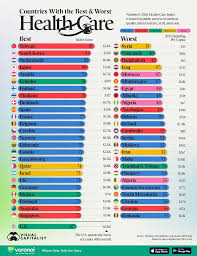
This graphic highlights the world’s top healthcare systems based on Numbeo’s 2026 Health Care Index, which measures public satisfaction with medical quality, hospital infrastructure, healthcare staff, waiting times, and treatment costs.
According to visualcapitalist, Taiwan ranks first overall with an index score of 87 while spending roughly $2.4K per person annually on healthcare. By contrast, the U.S. spends about $13.5K per capita, more than any country in the ranking, yet places 40th overall.
The results highlight a broader global pattern: some of the world’s highest-performing healthcare systems achieve strong patient outcomes without the world’s highest healthcare spending.
The Strongest Health Care Systems
One of the clearest patterns in the rankings is that the world’s best healthcare systems are not necessarily the most expensive. Top-performing countries tend to prioritize broad access, preventative care, and efficiency over sheer spending.
READ: Africa: Egypt’s Medical Tourism Surges 76.7%, Generates $8m in 2025
Taiwan is a prime example. Its single-payer system covers nearly the entire population while keeping administrative costs relatively low. South Korea and Japan also combine universal coverage with dense hospital networks, helping drive strong public satisfaction.
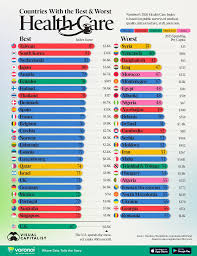
Europe also dominates the rankings, accounting for more than half of the top 25 healthcare systems. Nordic and Western European countries consistently score highly due to broad access, lower financial barriers, and strong patient care performance.
Thailand (#8) and Ecuador (#6) both rank surprisingly high despite spending only a fraction of what wealthier countries spend per capita on healthcare. Their rankings suggest that broad access and system efficiency can matter as much as total spending.
The Countries With the Lowest Healthcare Rankings
At the bottom of the ranking, the weakest healthcare systems are concentrated in countries facing economic instability, conflict, or chronic underinvestment.
Syria ranks last overall with a healthcare index score of 35, reflecting years of war and damaged medical infrastructure. Venezuela, Bangladesh, and Iraq also rank near the bottom, alongside several African economies struggling with physician shortages and limited hospital capacity.
In many lower-ranked countries, conflict, inflation, or chronic underinvestment have weakened hospital systems and reduced access to doctors, medicine, and basic treatment services.
America’s Healthcare Paradox
The U.S. spends more on healthcare than any country in the ranking, at roughly $13.5K per person annually, yet ranks just 40th overall on Numbeo’s 2026 Health Care Index.
Despite record healthcare spending, many Americans still struggle with affordability, wait times, and access to care, issues that lower-cost systems in East Asia and Europe often manage more effectively.
The disconnect has fueled years of debate over the efficiency of the U.S. healthcare system. Critics often point to high administrative costs, expensive prescription drugs, fragmented insurance coverage, and unequal access to care as major cost drivers.
The rankings reinforce a broader pattern: higher healthcare spending does not always translate into a better patient experience. Increasingly, efficiency, not just spending, is emerging as a defining factor behind top-performing systems.
