
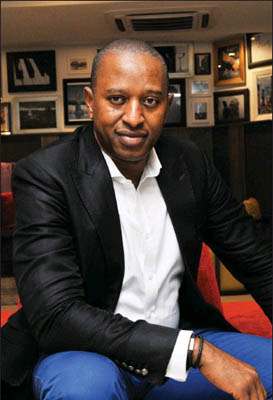
Anselm Tabansi recently rolled out the second hotel under his Fahrenheit Hospitality brand, the Fahrenheit Loft. He tells Demola Ojo the idea behind the brand, what sets it apart, its relationship with his interior décor business and more. Last weekend, Anselm Tabansi formally launched the second hotel under his Fahrenheit Hospitality brand, the Fahrenheit Loft in Victoria Island, Lagos. The 27-room Loft is a snazzy boutique hotel, which follows closely on the heels of the success of its predecessor, the Maison Fahrenheit, also in Victoria Island. It is safe to say that Tabansi – who is better known for his successful furniture fabrication and interior design company, Svengali Designs – has put on the garb of a hotelier.
“I’m a lawyer by profession. But I think design is my calling,” Tabansi starts during a chat at the Loft. “I practised for four years before I veered into interior design and furniture manufacturing.” He set up Svengali Designs in 1994. “Ever since then, my journey has been from producing wrought iron furniture, then multifaceted interior design. This is my main business.” However, Tabansi always had great passion for the hospitality industry and kept tabs on many of the pioneers, especially in the boutique segment. Also, by virtue of the fact that he produces furniture, he has done a lot of hospitality projects for people over time. All the while he was in construction, he had it at the back of his mind that he just might take the plunge into the hospitality business. “I was designing hotels for people but then, just generic hotels, nothing special,” he says. “The first hotel I designed was for the former Minister of Tourism and Culture, Chief Edem Duke, in Calabar. I designed his first hotel, furnished it, and also designed his second hotel too.” Tabansi also designed hotels in Port Harcourt but according to him, nothing very inspirational.
“I’ve always had great, quirky ideas on how to do things but you know, costumers just want to cut costs. They want you to just provide the rooms. At the time, customers weren’t too demanding.” He recounts working on a hotel for a client in Enugu. “About that time, most of the hotels they had in Enugu went for around N10, 000. Generic hotels where roadside carpenters put the furniture together. Nobody cared, there was no standard. So I told this guy who was living in California – I met him through a mutual friend – that I would do something out of the books for him. At some point, we travelled to Las Vegas jus to look at some of the concepts there, because he wanted to do something unique also.”
Tabansi’s client got unsolicited advice from watchers. “People were telling him ‘No, you can’t recover your costs’. I told him: ‘There is a percentage of rich people in Enugu that don’t have anywhere to go. People come in to do business with the government and don’t have anywhere decent to stay.’ I convinced him that he would not regret it. He would be a hit. He bought into my idea. We executed. From the day he opened shop, he was the number one hotel in Enugu. Even the governor at the time would lodge his guests there because it was very close to the Governor’s Lodge. “And that set the tone for hotels in Enugu. Everyone else now had to raise their standards.”
Filling the Void
At some point, Tabansi did an empirical study of the hotel industry in Nigeria and found out that there was something lacking. “There was very little emphasis on customer experience, customer satisfaction. There was very little emphasis on design.” He explains. “I mean, if you know about hospitality then you know it’s a lifestyle business. The whole concept about hospitality is that people leave their home, come to a hotel and then they feel much more than they feel when they are in their own home. A situation where you go into a hotel and nothing works; where there’s supposed to be hot water, it’s cold, where there ’s supposed to be clean linens, it’s brown, where there should be good service, it’s not there, you don’t want to stay. “The idea is that they (hotels) suck you into their environment and they want to keep you for as long as possible by the type of service that you’re offered. You enjoy it, you don’t want to go home. If you book for one day, you might find a flimsy excuse to extend for another day, just because you enjoyed yourself.”
For Tabansi, the boutique segment took the whole essence of service to a totally new level. “There’s a guy called Ian Schrager, to me the main promoter of the boutique style hotels. This was a guy that was co-founder of the famous Studio 54 nightclub in New York with his partner Rubell. And, Studio 54 was huge. It was like a melting pot hangout place for the stars in the movie and music industry.” The Studio 54 partners found out that after having a good time till the early hours of the morning, their customers had to drive a distance to get back to base. “…So they came up with an idea; to design hotel where people can club and if they don’t want to go home, they can stay over. They came up with the concept to design something different from the generic hotels you have around. “They came up with the concept of lobby socialising, where as you walk into the hotel, it’s like a party atmosphere. You know, music blaring from the lobby to the restaurant to the poolside, all one party atmosphere. And that (concept) became a monster hit. They were shocked by the acceptance. So that was how the whole idea of boutique hotel started. And that’s how they now eventually shut down Studio 54 and started rolling out boutique hotels all over the world.”
Tabansi also names Phillip Starks as an inspiration. Starks is behind the design in some of Tabansi’s favourite haunts in London, Los Angeles and Miami. “I get a lot of inspiration when I walk into a room he designs. When I lie down, I absorb the design and the concept.” All the while, thoughts of replicating the captivating ideas of these forerunners gnawed at Tabansi. “Over the years as I stayed in these hotels and had such great time, I kept thinking,’ how come we don’t create spaces like this in Nigeria?’ That’s what inspired the whole idea of developing boutique hotels.” Unfortunately, he was never allowed to express himself, either through budgetary constraints, or because clients just wanted to get on with it.
“I wanted to do things outside the norm but nobody wanted that. When I tell them, ‘I want to do a boutique hotel for you,’ they don’t understand the concept. It kept worrying me.” A harrowing experience convinced him to take matters into his hands. “One time, I went to Katsina. When I got there, I asked the taxi to take me to the best hotel. When I got there, I couldn’t sleep. I had to use my kaftan to cover the pillow for me to put my head on. And I kept looking at my watch all night to know when it is daybreak so I can get out. I said ‘this is the best hotel’, they said ‘yes’. So I made up my mind that I have to come into the industry, to deconstruct this industry and take it to a new level. So that’s how the whole idea of Fahrenheit came about.”
Reciprocal Passions
Tabansi is quick to stress that his foray into hospitality is born out of passion too. “My passion is two-pronged and I think that is the great advantage that I have. I have a great passion for interior design. I was the past president of Interior Design Association of Nigeria. Design has always been part of my DNA. Then I now love hospitality.” He confesses to loving the hotel experience. He doesn’t stay with family when he travels abroad. “My parents couldn’t just understand it.” He decided that if he were to invest in the industry, he would only do something that will resonate with the demographic of our society that appreciates an arty atmosphere. “There are a few guys that would swear by boutique hotels anywhere they go around the world,” Tabansi says, “and I know there know there are loads of them here. Nigerians are well-travelled and loads of them who have money like the life, they like to go to exquisite lounges, clubs and hotels to stay. Why can’t we provide these things for them?
“I had a conversation with one of my friends and I said the reason why a lot of Nigerians travel frequently is because we don’t have places for them to keep them here. So we’re always looking for that experience outside the shores of Nigeria. “When I decided I was going to do this, I decided that I needed to raise the bar in the industry. I needed to redefine the whole concept of hospitality in Nigeria.”
‘Courage of Conviction’
From his bullish, confident demeanour, it’s easy to assume that the transition from design guru to a hospitality brand head has been a cakewalk. “Don’t get me wrong, it hasn’t been an easy journey,” he clarifies. “There have been twists and turns along the way. Especially when you get into an industry that is not your forte, first of all, you need to learn the ropes. “I’ve lost money. But I was determined that I would make it work. And for me, it’s not just developing hotels. I also wanted to invest in the management side of hotels as well. That’s what led me to set up Fahrenheit. Presently, we have hotels that are not Fahrenheit-branded but are managed by us.”
Tabansi elucidates more on challenges. “Part of the challenge is that there’s a dearth of well-trained hospitality experts in Nigeria because we are not known for our hospitality expertise. It’s one of the biggest challenges that we have. That’s why it’s taken me a bit of time to really develop the business. But I have courage of conviction that I’m on the right path. I don’t care how long it takes me, I will never waver until I achieve my aim. And one of my aims is to ensure that the Fahrenheit Hotel is in every state capital in Nigeria.”
Lofty Plans
If one Fahrenheit per state sounds like a tall order, it is just the beginning for him. “Not that I would restrict myself to one in each state. By the Grace of God, we have launched two in Lagos. We have one in the pipeline in Ikoyi coming up with some partner. We’re also talking to somebody in Abuja as well. The other thing we’re also doing is franchising. Because we found out that the first product (Maison Fahrenheit) really resonated with people. So I’m talking to somebody in Mali. I went there some months ago. We’re also talking to some family in Ghana as well. So, at the end of the day, it won’t just be localised in Nigeria. It’s something we want to export. “We’ve found out that by the power of our design, we’ve been able to conquer the boutique segment as far as hospitality is concerned. It has really resonated with people so we’re going to keep pushing it.”
Aggressive Roll-out
The success of the Maison Fahrenheit must have prompted the roll-out of the Fahrenheit Loft so soon after, right? Tabansi says the two projects were actually running concurrently. “I was doing this too (Loft) at the same time. Let me tell you the truth. I think maybe I would say I was overly ambitious. At a time I had about four properties that I wanted to do as Fahrenheit Hotels. Eventually, I lost two of them because I was constrained by finance. I had Maison Fahrenheit and Farennheit Loft. I had one in Abuja, Fahrenheit Asokoro, and Farehnheit Lekki. “Eventually, I gave up on those two properties because I realised it wasn’t a tea party, it wasn’t something I could do. So I decided to rejig my original plan of aggressive roll-out. Because unless you have the war chest to execute this programme, you’ll find that it’s not feasible. My hope is that at some point, I will get the right finance that I need.” He is not looking to the banks for support though. “I don’t want to go into loans anymore. I’m looking for private equity. I’m also looking for angel investors who can see my vision, buy into it, and then let me execute.”
Synergising Svengali and Fahrenheit
The genius behind Anselm Tabansi’s foray into hospitality is how well his new venture piggybacks on his first business. “To be frank, this is an extension of my interior design business because boutique hotel is really about design,” he says. “Also what I’ve done is that the synergy I’ve created between Svengali Group and Fahrenheit Group, is such that I’ve created a value chain across board so that from conceptualising, to design, then construction, then outfitting, to supplies, furnishing, management. it’s all under my belt. So I control the whole value chain. That way, I cut down on my costs, quality assurance is ensured because I supervise everything, and costumer experience is also assured.“
Blue Ocean, Red Ocean
Tabansi has an interesting analogy to describe his business strategy. “I always say to my staff that in this hospitality market space, there’s what you call the blue ocean and the red ocean. We want to play in the blue ocean. Now the concept of the blue ocean is that you differentiate yourself by presenting something that is completely different from your competition. So you’re not swimming with the sharks. “When you come to a pool where there are sharks, it’s bloody. That’s the red ocean. The generic hotels, they’re all fighting for the same space. But the boutique hotel appeals to a different demographic. Once those ones come into your boutique property, they don’t want to stay anywhere else. That’s what I call the blue ocean. That is the space that we are operating in. We differentiate ourselves by our design.”
By playing in the blue ocean, Tabansi’s targets design aficionados, the upwardly-mobile, people in the arty world, those in the entertainment industry and young people with a sense of taste and style. “I’ve always said that you know any person with a sense of style. Because it reflects in everything that he does. From his dressing, to his car, to his women. Everything. It’s an all-encompassing thing. “So you see a guy who drives a flashy car, who drives a nice ride, chances are he’ll find a boutique envronment a comfortable space. That’s why if you come to the Maison, you will see Ferraris and McLarens. Those are the kind of guys.”
Tabansi goes the extra mile to explain that while his brand may appeal more to the young demographic, age is a thing of the mind. “For instance, I have an 85-year-old man that comes to the Maison. He loves the space. He swears by it. He brings his friends. He’s very proud of me. So it’s really a thing of the mind because there are some young people who are very conservative, they see this as too arty for them. “But the important thing is that you want to create a space that gives that ‘Wow!’ experience to any guest that walks into it. From the moment they walk into your reception, they get an impression of what the room would look like.”
Setting the Loft Apart
Despite both being Fahrenheit brands, the Maison and the Loft have subtle differences. “What separates the Maison is that it has a very elegant rooftop which is very popular.” But he could have built that at the Loft, couldn’t he? “The reason I didn’t do that is I don’t want to compete against myself. Maybe in Abuja I can do something with a rooftop but I don’t want to do it within close proximity of each other.” He goes further with a few more differences. “Here (the Loft) is a more cosy lounge. You can see the way I fused the restaurant and the lounge within a particular space. The idea is to come here and play, eat and live within one environment. “This place will appeal more to the business market than Maison. Maison is a more flirty environment. But here, the rooms are more spacious. There’s more detailed design at Maison than here but here you have a calmer environment, a more spacious environment, a more business-like environment.”
http://www.thisdaylive.com/articles/tabansi-boutique-hotel-really-about-design/216288/
