
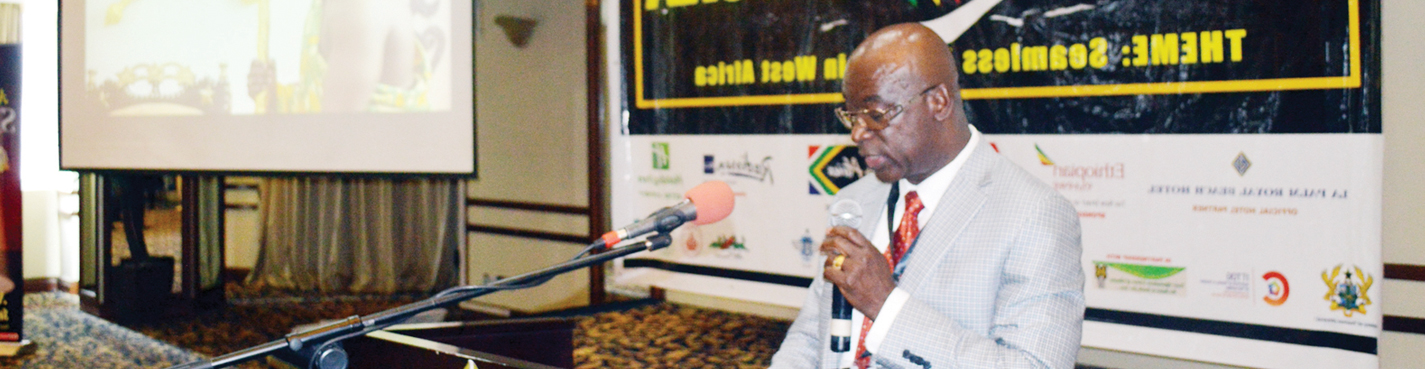
By Dr. Kwabena Adjei, Group Chairman – Kasapreko Company Limited
For us at Kasapreko, our vision is to build sustainable brands across Africa and the globe. Being a robust player in the private sector, it is of importance that we consistently evaluate opportunities that will foster growth and sustainability in the area of regional integration.
Ladies and gentlemen, regional integration is however no new phenomenon. It can be said to be an arrangement for enhancing cooperation through regional rules and institutions entered into by states within the same region. Regional integration could have as its objective political or economic goals, and in some cases, a business initiative aimed at broader security through a commercial purpose.
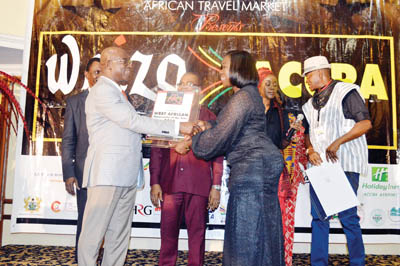
Dr. Kwabena Adjei – Founder Kasapreko receiving an Award of West African Personality of the Year from Hon. Mrs. Elizabeth Ofosu-Adjare – Minister of Tourism,
In 1828, for example Prussia established a customs union with Hesse-Darmstadt. This was followed successively by Bavaria Württemberg Customs Union, the middle German Commercial Union and other successive unions. This wave of integration spilled over into what was to become Switzerland when an integrated Swiss market and political union were created in the year 1848. Integration fever again struck Europe in the last decade of the nineteenth century when a lot of projects which are all no longer in remembrance were formed for the European Integration reference – (“the logic of regional integration: Europe & Beyond” by Walter Mattli). Ladies and gentlemen there is no doubt that this concept of regional integration has a long history that is still existent in various shapes or forms in this present day.
In our part of the world, Africa to be specific, we have also had various bodies responsible for enhancing cooperation through regional policies and institutions under the African Union which succeeded the Organization of African Unity (OAU). Africa’s current integration landscape contains an array of Regional Economic Communities, namely:
- The Community of Sahel-Sahara States
- The Economic Community of West African States (ECOWAS),
- Common Market for Eastern & Southern African States (COMESA),
- Economic Community of Central African States (ECCAS),
- East African Community (EAC),
- Arab Maghreb Union (UMA),
- Southern African Development Community (SADC),
- Intergovernmental Authority on Development (IGAD).

Delegates at Kasapreko stand during Weizo Accra 2015
Ladies and Gentlemen, the common objective that cuts across these communities, is the fact that they are mostly grouped together by individual countries in sub regions for the singular mission of promoting greater economic integration within the regions under the aspiration of the creation of creating higher value across the block than what can be envisaged by every single member. These 8 blocks I have previously mentioned are described as the ‘building blocks’ of the African Union. The concept of good faith and the resultant observance of treaty obligations are the basis on which Member States must make regional integration decisions as well as ensuring their performance and implementation.
I will zoom into our topic on “THE ROLE OF THE PRIVATE SECTOR IN REGIONAL INTEGRATION” with specific focus on The Economic Community of West African States (ECOWAS) which is the regional economic body made up of 15 West African member states. It is worth noting that regional integration strives on political will and stability. Ghana continues to enjoy and reciprocate good cooperation with member countries. Governments over the years have signed treaties that will promote trade amongst member countries, enabling a positive atmosphere for private business to thrive.
Ladies and Gentlemen, trade amongst member countries in the block is key to economic development. A flourishing private sector within regional integration will translate into numerous benefits to member countries in the areas of
- Job creation.
- Revenue generation.
- Exchange of knowledge/skill acquisition.
- Economic stability and growth.
- Promotion of culture and tradition ties amongst member states.
Permit me to expantiate these benefits further;
- In the area of job creation, the more business opportunities we create through regional integration, the more job opportunities we create for citizens across various countries in ECOWAS. Let’s take Kasapreko for example which is a leading beverage company in Ghana and well celebrated for its popular brands such as the award winning and internationally recognized Alomo Bitters, Kasapreko London Dry Gin, K20 Whisky, Kasapreko Lime cordial, Tonic Wine just to mention a few, the company employ’s close to 400 people in its head office in Ghana. Four years ago, we expanded into Nigeria by setting up a country office with a current staff strength of over 40 employees to support our import trade partners in that country for the marketing, sales and distribution of Alomo Bitters and recently Carnival Strawberry, Kalahari Bitters and Alomo Silver. We expect to double our staff numbers in Nigeria over the next 12 months. We also have distributors in Burkina-Faso, Cote d’Ivoire, Togo and Liberia who have also invested in man power to help run their distribution business. Ladies and Gentlemen, imagine the number of employment opportunities we can create for our people directly and indirectly as we encourage trade amongst ourselves with little to no barriers? If Kasapreko has started this in its own very little way, one can imagine the magnitude of impact as the number of West African businesses expanding out of their frontiers increase?
- With an increase in trade amongst member countries, value will be created, with value being created, revenue would be generated directly as well as indirectly through taxes and levies across the individual member states and the block which can be channeled into the public sector for developmental activities in line with government policy.
- Through corporation in trade and commerce, we will create the avenue for the exchange of knowledge, experience and skill acquisition. We are endowed with a lot of professional and skilled human resources which becomes available for others to leverage as the forces of demand and supply determine.
- Growing trade amongst member countries will lead to economic stability that will reflect positively on our currencies, GDP, inflation and other economic indicators. This is key, if the Europeans managed to strengthen their economies through the European Union (EU), why can’t we do same in ECOWAS?
- We are a region full of rich and diverse culture and traditions, by working together not only do we promote trade that will lead to profits but we also promote our collectively rich culture and traditions which are fast dying. We also build our tolerance levels as we experience different cultures and assimilate them into respective member states through free movement and job seeking needs.
Ladies and Gentlemen, we however have a number of pitfalls that are stifling private sector growth and participation in regional integration, I will mention a few as follows;
- Local laws supersede that of ECOWAS: It has sometimes proven challenging to implement some decisions taken at the ECOWAS level by respective member countries as a result of existing local laws which officials apply or refer to whilst discharging their duties.
- High tariffs and strict border controls: Tariffs differ from country to country within the sub region, the landed cost of products are mostly high, in the case of alcoholic products such as Alomo Bitters, importers are faced with almost 100% charges in the form of duties, taxes and levies on the cost of the products. This mainly applies to Liberia and the Francophone countries who do not recognize the ECOWAS Trade Liberalization Scheme (ETLS) as a result of their membership of the West African Economic and Monetary Union (UEMOA). Nigeria on the other hand deserves great commendation for their recognition and application of the ECOWAS Trade Liberalization Scheme (ETLS). This coupled with strict border control processes serves as disincentive to importers and reduces the commitment levels of customers as well as discouraging potential customers from transacting business with us.
- Pockets of instability in some member countries in recent times for example the Ebola pandemic in some of the member countries (Liberia, Serra-Leon and Guinea mainly) as well as the brief political instability in Burkina Faso, high tension experienced during the recent Nigerian elections, to mention a few, prevented businesses from investing in most of these countries. On the flip side, the current power crisis in Ghana, the increasing depreciation of the Ghana Cedis, high utility tariffs as well as continuous increase in fuel prices is not attracting potential businesses and heaping a lot of pressure on local operations.
- The Francophone block is a ‘sub economic’ zone within ECOWAS and very difficult to manage as a result of their common monetary policy and over protectiveness over currency movement. They also have very strict border controls which I have already mentioned but want to lay emphasis on, in this regard. The English speaking countries on the other hand use 6 different currencies with each of them experiencing their respective challenges in terms of depreciation vs the CFA Franc and other international currencies. It is unfortunate that the Anglophone countries have not been able to achieve their common currency agenda which started over 15 years ago. Language barrier is also a major difficulty in doing business in West Africa.
- Weak dispute settlement mechanisms, often prevents private businesses to invest in member countries. There is high lack of trust in working together to resolve disputes/conflicts, member countries are most often more comfortable with working with former colonial countries or other international bodies to mediate during crisis. This practice weakens investor confidence in our integration measures, and casts doubts in the mindset of these investors.
Ladies and Gentlemen, having spoken about benefits and pit falls in relation to private sector participation in regional integration, I wish to put across the following suggestions that may help in arriving at a full potential of the private sector’s role in regional integration.
- To start with, private sectors should harmonize in areas such as trade tariffs and border controls as well as integration in information and communications technologies (ICT) not forgetting financial infrastructure. It should be noted that these sectors form the backbone of regional integration that has in mind its objective as meeting economic goals. With the area of ICT, it should be noted that it will aid private sectors to fully utilize the benefits the sector can offer for economic growth as well as individual businesses.
- Again, at the regional level, it requires that competing interests make use of a range of forums for co-operation. This therefore demands all private sectors to comply with this rule so as to help achieve this policy since if it succeeds it will in the long run aid (i.e. the private sector institution) growth of our businesses in a sociable environment.
- The private sectors should fully participate in various bodies that are involved with the policy of regional integration as well as join groups that focus on ensuring that this policy is implemented. An effort to enhance advocacy further facilitate the strengthening and implementation of policies.
- On the issue of language barrier, I will recommend that we all take this seriously and invest in acquiring knowledge and fluency in both languages. The world is fast moving, we shouldn’t be left behind. We can never change our neighbors, it is up to us to reduce all barriers that will inhibit growth and stability. As simple as it may seem, multi lingual capability has far reaching capabilities.
- Finally, trust is key in everything we do, let us strengthen the various institutions available to us, and as the private sector invest to get these structures to work for our common interest.

Kasapreko staff posing for a photograph at their stand
For us at Kasapreko we began our journey into promoting our brands in West Africa and beyond four years ago. Our flagship brand Alomo Bitters, a natural herbal spirit drink, made of a blend of carefully selected tropical plant extracts to give our consumers that desired goodness. Alomo Bitters is unique to other spirit drinks as a result of its natural herbal content. Awarded a Super Brand in 2012 and Ghana’s tourism drink of the year 2014, Alomo Bitters is well consumed and very popular in Nigeria and was also awarded Medicinal Herbal Drink of the Year (2014) by the Institute for Government Research Leadership Technology (IGRLT) in Nigeria. Alomo Bitters is also available in Togo, Benin, Cote d’Ivoire, Burkina Faso, Liberia, South Africa, Europe and North America, Alomo Bitters was ranked amongst the top 5 alcoholic brands to go big globally in the next few years by CNN money pole in October 2014.
We recently introduced a second variant, Alomo Bitters Silver which is minty with a reduced alcohol content. To quote consumers, “it is smooth”! Our R&D and commercial team are continuously working through research to introduce other Alomo variants to satisfy consumer tastes. I will encourage you all to have a taste of Alomo Bitters and other Kasapreko products after our session.
Ladies and Gentlemen, the future is bright, and the future is integration that works. The private sector will continue to be very instrumental in oiling the integration machine, but it will only come when we work at it and never through wishful thinking. I wish to express my appreciation once again for this opportunity.
Thank you!
