
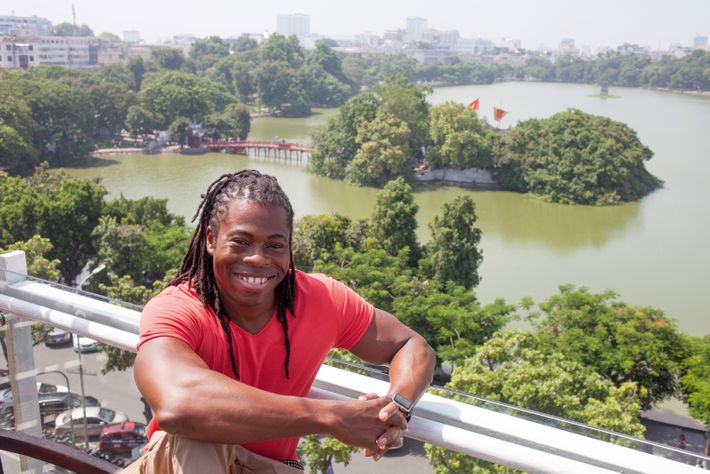
Ade Adepitan is a Nigerian- born British presenter and also a Wheel- Chair Basketball player. He reviews his journey across continents in this piece from his latest BBC TV series titled Africa with Ade Adepitan as reported by ww.nationalgeographic.co.uk
Excepts:
Ade Adepitan’s transcontinental journey began in Cape Verde, and travelled through Senegal, Ivory Coast, Nigeria and Somalia.
How did you come up with the idea for your TV series, Africa with Ade Adepitan?
It’s something I’d wanted to do for decades. As a child watching the news in the UK, all the images I ever saw of the African continent were of war, corruption or poverty. I wanted to change that. So, for the four-part BBC Two series, I travelled through what, as we aimed to show, is such a fun, exciting, diverse continent — not one homogenous place. It was part travel, part current affairs. I also wanted to do a homecoming story of sorts, as I moved from Nigeria to London when I was three years old.
Where did you travel to?
We wanted to make a transcontinental journey, starting from Cape Verde in the west, travelling east but we were led somewhat by what was feasible politically.
Sudan, for example was difficult to travel through at the time, with war and insurgent activities. Our mission was to find people to talk to, great characters, and give them enough time to tell their unique stories. It’s the people who take you on a journey, as much as the place. We met young footballers in the Ivory Coast, which has become a football factory — exploiting its young talent, building unscrupulous academies where teens are trained, then sold off to highest-bidding European teams. Similarly, in Nigeria — the coding capital of the world — we met tech workers whose coding genius is being outsourced to the US and beyond.
What made the biggest impact on you?
Cape Verde was really interesting. When we visited, it was at a key stage of switching away from fossil fuels to being a country totally reliant on natural energy. Cape Verde was a main stop-off port between Europe and the Americas, where all the ships would refuel and restock. It’s a country built on the slave trade, long exploited for its resources. And now, with little left to extract, things can change. You can’t take away wind and sun. Cape Verde can become self-reliant with these resources. I wanted to tell that story.
When we travelled from Cape Verde to Senegal, we followed the story of the slave trade, seeing the places where slaves were kept, in unfathomable conditions. Some of the most sought-after slaves came from the Uraba tribe in Nigeria, where I was born. It was a shocking realisation for me.
Adedoyin Adepitan was born in Lagos Nigeria. At the age of fifteen months he contracted Poliomyelitis. The effects of the virus meant that Ade was unable to use his left leg, and only had partial use of his right leg.
In 1976 when Ade was three years old. His parents decided move to the UK were it would be easier to bring up a child with a disability. They settled in Plaistow East London. Moving to the UK was one of the most important events in Ade Adepitan’s life. He was taught how to walk using iron callipers, which he wore until the age of 17. Despite having Polio, Ade loved playing football with his school friends. He spent his early years dreaming of playing football for England.
By Francis Ogwo
Source: www.nationalgeographic.co.uk
