
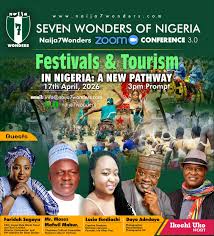
What began as a conversation around Detty December has now evolved into something far more expansive and urgent. At the ongoing Naija7Wonders Zoom Conference 3.0, the spotlight has shifted to a broader, more strategic theme: “Festival and Tourism (In Nigeria:
A New Pathway).” At the heart of this transition was a compelling intervention by Lucia Ikediashi, whose lived experience in the cultural and tourism space reframed festivals not just as moments of celebration, but as powerful economic engines waiting to be fully activated.
Lucia’s story did not begin with a grand tourism strategy; it started with a simple question. Speaking during the session, she recalled her early days volunteering at an international film festival, where a glaring gap caught her attention: no one had planned how to receive international guests.
“I asked them, who is picking these people from the airport? And they said nobody. That was how I plugged myself in,” she said.
That moment became her entry point into tourism logistics, eventually growing into a full-fledged role managing hospitality and visitor experience. It was a modest beginning, but one that revealed a recurring theme across Nigeria’s festival ecosystem: great ideas, but limited structure.
As Obi Asika noted, Nigeria is not lacking in cultural assets.
READ: Africa: Festivals Must Be Repackaged as Tourism Products in Nigeria– Lucia Ikediashi
“We have over 850 cultural festivals. So it’s not that we don’t have enough, we just need to package them properly,” she noted.
From long-standing events like Felabration to community-rooted celebrations such as Ojude Oba, Nigeria’s cultural calendar is rich with experiences that already draw crowds. However, Lucia stressed that the missing link is intentional packaging and experience design.
“Festivals should not just be celebrations, they should be tourism products,” she said.
According to her, people do not travel simply for destinations; they travel for experiences. Using Felabration as an example, she explained how curated itineraries can transform a single event into a multi-day tourism journey that includes storytelling, cultural immersion, and exploration of surrounding locations.
“It’s not just about going to the shrine. You can take them to Abeokuta, tell Fela’s story, show them culture and food; create something they will never forget,” she added.
She noted that this approach encourages visitors to stay longer, spend more, and build lasting connections with the destination. For events like Ojude Oba, she observed that repeat visitors often return not just for the spectacle, but for the sense of belonging created through shared cultural experiences.
Drawing comparisons with regional examples, Lucia pointed to Ghana’s festival ecosystem, particularly her experience working on the Asabako Festival in Busua. She described a level of preparedness among local vendors and service providers that enabled them to fully capitalize on the influx of visitors.
“People were coming specifically for the festival. Even when the accommodation was finished, people created alternatives like tents. Everybody was ready to earn,” she said.
Her remarks highlighted the need for Nigeria to better structure its response to demand, turning spontaneous interest into organized economic opportunity.
Lucia also underscored the broader economic ripple effect of festivals, noting that their impact extends far beyond event organizers. From fabric sellers and hairstylists to transport providers, security personnel, and sanitation workers, festivals create opportunities across multiple layers of the economy.
“Anybody can benefit. If the money is good, people will find a way to be part of it,” she explained.
She further pointed to overlooked cultural and economic assets, such as shea butter production in Ilorin and cocoa processing in parts of Ogun State, as examples of experiences that can be integrated into festival tourism offerings.
“These things we think are small, they can actually drive the economy,” she said.
Through her own initiative, Irie Vibes Fest, Lucia has applied many of these principles in practice. The festival, which combines reggae music with cervical cancer awareness, has grown into a platform that merges culture, advocacy, and community impact. Supported by stakeholders including the Nigerian Association of Tour Operators (NATOP), the event has also contributed to health outreach efforts, including free screenings for women.
“It’s a shared experience. People come for the music, but they leave with something deeper,” she said.
She also shared how exposure from the festival has created opportunities for creatives, including an artist who secured international recognition after performing at the event.
Beyond programming, Lucia emphasized the importance of data, branding, and long-term planning in scaling festivals into viable tourism products. She called for improved tracking of attendance, visitor behavior, and spending patterns, noting that such data is essential for attracting investment.
“How will investors come if they don’t see returns?” she asked.
She also advocated for the creation of a centralized national festival calendar to help both local and international tourists plan their visits effectively.
“If people know what is happening and when, they will plan to come,” she said.
Branding, she added, must extend beyond the event itself, with merchandise and visual identity playing a role in sustaining visibility and engagement.
Her recommendations echoed broader sentiments expressed during the conference, including earlier contributions from Ikechi Uko, who has consistently advocated for a more structured approach to tourism development in Nigeria.
As discussions continue, the message emerging from Naija7Wonders Conference 3.0 is clear: Nigeria’s tourism potential is not in question, but realizing it will require a shift from isolated efforts to coordinated systems.
Lucia’s closing reflection captured the essence of this evolving conversation: “It’s not about the place anymore. It’s about what people will experience there.”
With that, the conference’s new direction, toward festivals as structured tourism pathways, appears not only timely but necessary.
Sam Opoku
