
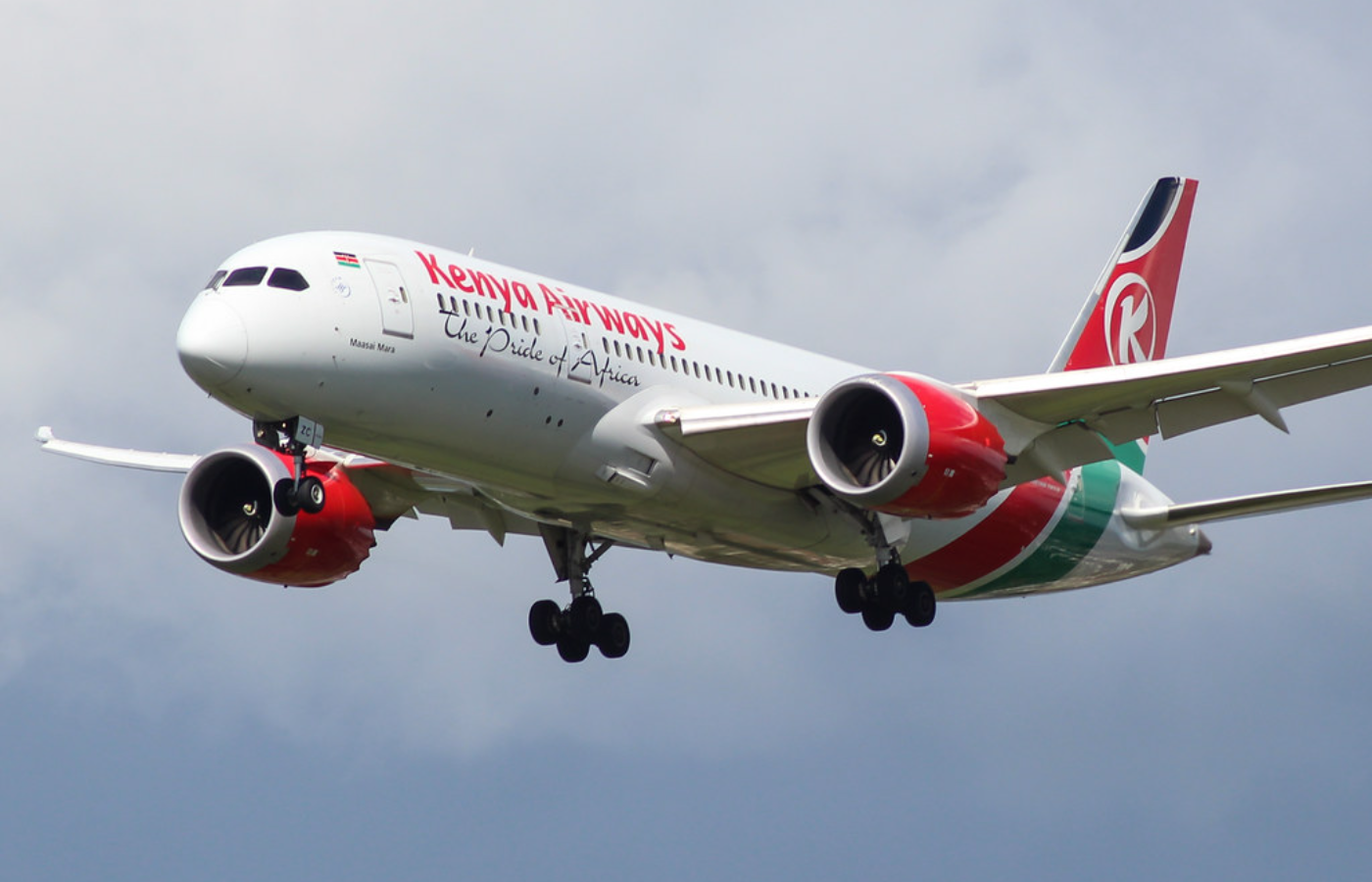
Kenya Airways (KQ) officially reported a net loss of Sh17.12 billion ($132.1 million) for the financial year ended December 31, 2025.
This marks a dramatic reversal from the Sh5.4 billion ($42 million) net profit posted in 2024, which had been the airline’s first profitable year in over a decade.
According to Birr Metrics, the loss, disclosed on March 24, 2026, follows a difficult year marked by falling income, reduced capacity and rising financing costs. Total income declined to 1.24bln US dollars (Ksh161.5 billion) from 1.45bln US dollars (Ksh188.5 billion) in 2024, while operating costs reached 1.29bln US dollars (Ksh167.1 billion), resulting in an operating loss of 43mln US dollars (Ksh5.6 billion). After finance costs of 95mln US dollars (Ksh12.3 billion) and tax, the airline’s net margin deteriorated to negative 10.6 percent, from a positive 2.9 percent a year earlier.
The deterioration was already evident in the first half of the year, when the airline recorded a 93mln US dollars (Ksh12.1 billion) loss. Executives attributed the slump in part to fleet disruptions. Chief Finance Officer Mary Mwenga said three wide-body Boeing 787-8 Dreamliner aircraft were grounded due to global supply chain constraints, cutting operating capacity by about 20 percent and constraining revenue generation. Acting Group Managing Director and CEO George Kamal said the airline operated at just 80 percent of available capacity during the year, though he noted performance still exceeded pre-pandemic revenue levels.
READ: Africa: Middle East Conflict Drives Surge in Demand for Kenya Airways Flights
Two of the grounded Dreamliners are expected to return to service by mid-June, with additional capacity anticipated later in the year. The airline expects the return of a Boeing 777-300 from lease and the addition of a leased Boeing 737 NG by November. However, Kamal cautioned that longer-term fleet expansion will take time. “If you book today, the plane will come between 2030 to 2033,” he said, pointing to global aircraft supply bottlenecks. To stabilise operations, the airline is pursuing capital raising and restructuring measures, including cost optimisation, elimination of non-essential spending and efforts to convert fixed costs into more flexible structures.
The results come amid leadership changes at the carrier. Earlier this month, Kenya Airways appointed Kiprono Kittony as chairman, alongside several new non-executive directors, including David Ndii, as part of a broader governance reset. Kittony described the airline’s challenges as structural rather than demand-driven. “This is a period of reset and not retreat,” he said. “We are making decisions today to build a stronger, more resilient future.” The latest performance reinforces a broader divide within Africa’s aviation sector, where only a handful of carriers consistently report profits. Chief among them is Ethiopian Airlines, which has continued to expand despite regional headwinds.
Ethiopian Airlines reported revenue of 7.6 billion US dollars in its 2024/25 fiscal year, an eight percent increase, while carrying 19 million passengers and expanding both its fleet and route network. The airline has maintained growth momentum into the current fiscal year, supported by continued investment and long-term strategic planning. The contrast highlights the uneven recovery of African aviation, where capacity constraints, financing pressures and governance challenges continue to weigh on several national carriers even as demand for air travel remains robust.
