
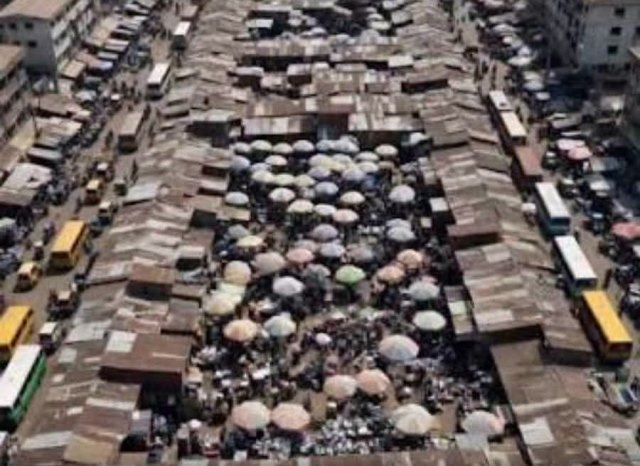
The multi-billion dollar mega-hub we see today, Alaba International Market, was born out of raw survival, state-sponsored displacement, and the pure, stubborn grit of exactly thirteen young Igbo men who refused to be crushed by the system.
It all started back in 1976 and 1977 when Lagos was undergoing a massive urban facelift. The government was desperate to clear out the insane traffic gridlock and unstructured street trading in central areas, especially around the old Alaba-Suru axis, Alaka Surulere, and Iponri Market near Costain.
By October 5, 1978, a small, tight-knit group of thirteen young electronics traders found themselves completely squeezed out of their trading spots with nowhere to go. Led by iconic pioneer business titans, these men formed the historic 13-man committee that would alter Nigerian commerce forever.
Among these legends was Chief Christopher Chika Ajokorom, a key pioneer who served as the original Treasurer of the founding committee and went on to lead as the Chairman of the Founding Fathers Council. Working right alongside him was Nze Ezeana Geoffrey S. M. Chukwujekwu (J.P.), who was officially recognized as a main architect and founder. Nze Chukwujekwu served as the first General Secretary of Alaba International Market from 1976 to 1980, became the second Chairman of the International Market Alaba Electronics section from 1980 to 1984, and later served as Chairman of the Founding Fathers Council, singlehandedly documenting the market’s complete timeline for history.
The group was heavily anchored by Nze Sunday Ekenulo Onuoha, popularly known in his lifetime as Nze Sunday Achonu, a legendary Igbo business titan from Amaigbo, Imo State, who was a principal founder who used his immense commercial networks to help drive the initial move from central Lagos to the Ojo swamp.
Facing total displacement, these founders went to the Lagos State Government to demand a relocation site. The authorities pointed them toward a remote, heavily forested, and waterlogged piece of land deep inside the Ojo Local Government Area along the Ojo-Igbede Road. Back then, Ojo wasn’t the bustling city it is today; it was a terrifying, swampy greenfield that was totally cut off from civilization, devoid of roads, and overrun by dangerous land grabbers and armed hoodlums known as Omo Oniles.
Most people would have given up, but these guys got tactical. To claim the land and protect it from thugs, Chief Ajokorom, Nze Chukwujekwu, and the founders sent their teenage Umu-boi( apprentices) to sleep on the bare, swampy ground completely unarmed. It was a fierce psychological move to signal to the people that the land was occupied.
The founding fathers also knew that thirteen people couldn’t build an empire alone, so they went on a massive recruitment drive. They traveled down to the old, established Jankara Market on Lagos Island and spent weeks convincing electronics and electrical spare parts merchants to pack up their things and move out to the Ojo swamp. The government didn’t give them a single Kobo for infrastructure. These early merchants pooled their own personal savings together, manually cleared the thick bush, bought tipper loads of sand to fill up the waterlogged swamp, and built their own access roads, drainage systems, and security posts.
Because these founding Igbo traders were deeply spiritual and believed their business could only thrive with divine backing and community unity, they didn’t just build shops—they immediately laid the foundations for spiritual anchors right inside the market. As soon as they got the market layout organized, the pioneer traders built major structures to anchor their faith and ensure everyone could worship peacefully.
They founded St. Patrick’s Catholic Church, which started on Catholic Mission Street as an out-station of St. Mary’s Ajegunle, it became major landmark for the predominantly Catholic traders. Right alongside it, they established St. Peter’s Anglican Church for the Protestant merchants, and the Alaba Central Mosque to ensure absolute peace and a harmonious relationship with Muslim traders and the host community. To this very day, St. Patrick’s Road and the famous Patrick Bus Stop remain some of the most heavily congested, legendary commercial arteries right inside the electrical and electronics section of the market.
By the early 1980s, their gamble paid off spectacularly due to a massive boom in the Nigerian music industry. Suddenly, everyone across the country wanted public address systems, amplifiers, and giant sound speakers. Alaba became the ultimate hotspot for importing and reconditioning iconic audio brands like Gibson, Philips, and Panabis. Instead of buying through expensive European middlemen, these entrepreneurs pioneered direct trade routes straight to manufacturing factories in China, Japan, and India.
When the Nigerian government introduced severe economic austerity measures and choked up the main seaports later in the 1980s, Alaba traders used their strategic location right along the Lagos-Badagry Expressway to move goods smoothly across the Benin Republic border, turning the market into an international powerhouse.
What really turned Alaba into a self-sustaining economic superpower was the genius of the Igba Boi apprenticeship system. Masters brought young boys from their villages in the East to serve them for five to seven years in exchange for food, housing, and a masterclass in global trade. At the end of the contract, the master would settle the apprentice with a massive lump sum of capital and a rented shop. This created an explosive multiplication effect where every settled boy became a new master taking on his own apprentices.
They also avoided traditional banks by using their own rotating credit unions, called Ajo or Esusu, to finance massive shipping containers purely on mutual trust. By the 1990s, Alaba became so powerful that it organically birthed the global distribution network for Nollywood, with executive generic marketers like Uba Pacific, Tjoe, and Iyke da Don funding and distributing VCDs and DVDs across the entire African continent.
Today, what started as thirteen displaced men led by Chief Ajokorom, Nze Chukwujekwu, and Nze Sunday Achonu in a desolate swamp has grown into an independent economic giant with over thirty thousand shops, a million daily customers, and more than two billion dollars in annual trade, all controlled by the highly organized Alaba International Market Association.
Did you know this was how Alaba International Market started?
If you have ever bought something, served an apprenticeship, or owned a shop in Alaba, tell us your experience in the comments!
Let’s celebrate the spirit of hard work
