
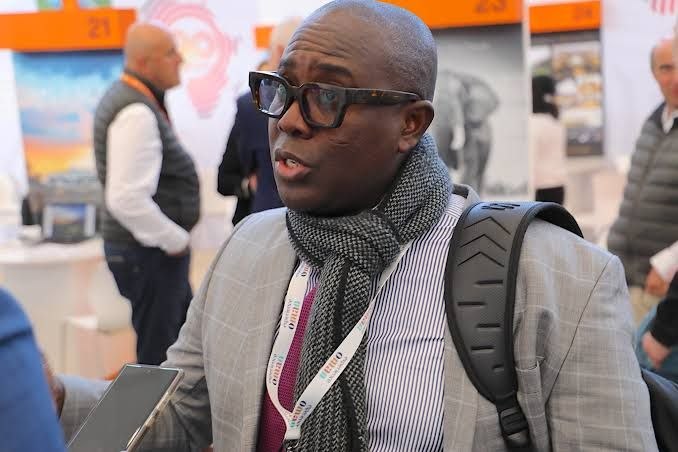
At the 2026 Akwaaba African Travel Market, Labadi Beach Hotel Head of Sales George Ayisi revealed plans to expand the Accra property by 100 rooms and add an ultra-modern conference facility, while highlighting technology, sustainability and the growing importance of Nigerian travellers to Ghana’s tourism economy.
For George Ayisi, Head of Sales at Labadi Beach Hotel, hospitality is not simply about putting up an impressive building beside the ocean. It is about what happens when the guest walks through the doors — and whether the service experience is good enough to make that guest return.
That philosophy has helped shape Labadi Beach Hotel for 35 years.
Speaking at the 2026 Akwaaba African Travel Market at Eko Hotels in Lagos, Ayisi presented the Ghanaian property as a hotel that has evolved alongside the country’s hospitality and tourism industry, combining leisure, business, meetings and conferences within a beachfront setting in Accra.
Established in 1991 and located about 10 minutes from Kotoka International Airport, Labadi Beach Hotel currently has 164 rooms across different categories. But the property is preparing for another major chapter.
According to Ayisi, plans are underway to add 100 additional rooms and an ultra-modern conference facility, taking the hotel’s room inventory to 264.
“In the next two years, when you come to Labadi Beach Hotel, you will not recognise it,” Ayisi said, describing the planned development as a transformation that will significantly increase the hotel’s capacity for business and events.
More Than a Beachfront Hotel
Labadi Beach Hotel’s location naturally lends itself to leisure tourism, but Ayisi said the hotel’s business strategy has increasingly embraced the corporate market.
The property has positioned itself to serve both leisure and business travellers, with corporate retreats, team-building programmes, conferences, incentives and exhibitions forming an important part of its market.
That MICE — meetings, incentives, conferences and exhibitions — positioning is particularly relevant as African destinations compete to attract regional and international conferences.
Ayisi believes Labadi’s ability to combine business facilities with a resort-style environment gives corporate clients an alternative to conventional conference venues.
“We are very, very ideal for MICE business,” he said, noting that the hotel accommodates both larger and smaller events as well as corporate retreats.
The hotel recently demonstrated that flexibility when a major conference created a demand for more space than its existing facilities could comfortably provide.
Rather than turn the opportunity away, the team developed a temporary conference centre using a marquee, creating a venue capable of hosting about 800 people.
For Ayisi, the experience demonstrated an important element of hospitality: the ability to respond creatively to a client’s needs.
A New Chapter for Labadi
Labadi’s planned expansion is not its first major growth phase.
Ayisi explained that the hotel began with 102 rooms before adding 60 rooms in 2010, bringing the total to its present 164.
The next phase will be considerably larger, with another 100 rooms planned alongside a modern conference facility.
The investment is significant because it reflects the changing requirements of the hospitality market. Hotels are increasingly expected to provide more than accommodation. Corporate travellers want meeting spaces, event infrastructure, connectivity and convenient services, while leisure travellers increasingly look for experiences, wellness, nature and distinctive environments.
Labadi’s expansion appears designed to address both sides of that market.
Service Excellence as the Product
For all the emphasis on new rooms and facilities, Ayisi repeatedly returned to one subject: people.
He argued that a hotel building alone does not create hospitality.
“Every property is a hotel. But is it just the building that makes the service? No,” he said.
For Labadi, staff training is therefore a deliberate investment rather than an afterthought.
The hotel’s approach is built around maintaining service standards across the different points at which guests interact with the property.
That focus has also been recognised within Ghana’s hospitality industry. Ayisi pointed to recognition from the Chartered Institute of Marketing, Ghana (CIMG), including Labadi Beach Hotel’s induction into its Hall of Fame as a five-star hotel.
For a property marking its 35th anniversary, the challenge is therefore not simply to preserve an established reputation, but to keep improving while the market changes around it.
Sustainability Becomes Part of the Experience
Labadi’s development strategy also reflects the growing importance of sustainability in hospitality.
Ayisi pointed to the hotel’s extensive coconut trees and deliberately maintained green environment as part of its approach to creating a more natural setting.
The emphasis is significant because sustainability in tourism is increasingly moving beyond a marketing message and into the physical design and operation of hospitality properties.
For Labadi, the natural environment is also part of the guest experience.
The hotel is therefore presenting itself simultaneously as a business venue, a leisure property and a destination for travellers who value nature.
“We are even a hotel that is ideal for nature lovers,” Ayisi said.
That combination could become increasingly relevant as travellers look for experiences that allow them to combine meetings, relaxation and local surroundings rather than treating business travel and leisure as entirely separate experiences.
Technology and the 24-Hour Guest
Technology is another area where Labadi is adapting to changing traveller expectations.
Ayisi said the hotel has incorporated artificial intelligence into aspects of its customer interaction, allowing guests to engage with the hotel beyond conventional working hours.
The reasoning is particularly relevant to an international hotel operating in a market where guests and prospective customers may be located across different time zones.
“We need to employ this AI as part of our technological infrastructure to ensure that we satisfy the customers that we serve,” he explained.
The move illustrates how artificial intelligence is beginning to enter hospitality not only through sophisticated back-office systems, but also through customer-facing services designed to improve accessibility and responsiveness.
For Labadi, technology is being positioned as an extension of service rather than a substitute for hospitality staff.
Nigeria Remains a Strategic Market
One of the strongest messages from Ayisi’s appearance at Akwaaba was the importance of the Nigerian market to Ghanaian tourism.
Nigeria is already a significant source market for Labadi, and Ayisi described the relationship between the two countries as commercially important to both sides.
He linked the growth in travel between Ghana and Nigeria to the broader push for easier movement among African countries, particularly within West Africa.
The relatively easy travel relationship between the two countries, he argued, creates an environment in which businesses, tourists and hospitality providers can develop stronger connections.
“For us, it promotes business,” he said.
The proximity of Accra and Lagos also makes the corridor particularly relevant for short business trips, conferences, leisure breaks and group travel.
For Labadi, Nigerian tour operators are therefore not simply intermediaries; they are strategic partners capable of connecting the hotel with travellers and corporate organisations in one of West Africa’s largest tourism markets.
From Jollof to Gastronomy Tourism
Perhaps the most colourful part of Ayisi’s interview was his discussion of food.
The famous Ghana–Nigeria “Jollof War” may be playful, but Ayisi believes the cultural fascination surrounding the dish represents a genuine tourism opportunity.
He suggested that a Ghana–Nigeria Jollof competition supported at a national level could become a platform for promoting gastronomy and cultural tourism.
For Labadi, the connection is already visible in its kitchen.
The hotel has a Nigerian chef who prepares Nigerian dishes for its guests, including edikaikong soup, ogbono and egusi.
Ayisi said this has proved particularly valuable given the number of Nigerians living in or visiting Ghana.
The strategy recognises an important reality in modern hospitality: travellers increasingly want elements of home even when they are abroad, while local and regional cuisine can simultaneously become part of the destination experience.
Labadi’s Nigerian food offering therefore serves both purposes — providing familiarity for Nigerian guests while contributing to a broader Ghana–Nigeria cultural exchange.
Akwaaba as a Business Platform
Ayisi’s presence at Akwaaba was ultimately about building relationships.
He described the African travel market as a platform where hotels, tour operators and travel agencies can establish the connections necessary to generate business beyond the exhibition floor.
For Labadi, that means using the event to strengthen existing Nigerian relationships while identifying new partnerships that can support the hotel’s next phase of growth.
The hotel’s 35-year history has given it a strong foundation, but Ayisi’s message suggests that longevity alone is not enough.
The next phase will require larger facilities, stronger MICE capabilities, continued staff development, sustainability, technology and deeper engagement with regional markets.
And Nigeria sits prominently within that strategy.
As Labadi Beach Hotel prepares to move from 164 to a planned 264 rooms, its expansion reflects more than the growth of one Ghanaian hotel. It points to a broader evolution in West African hospitality — one where hotels increasingly compete through experiences, events, technology, regional connectivity and cultural relevance.
For Ayisi, the direction is clear: Labadi’s future will be built on the same foundation that has sustained it for three and a half decades — but with the capacity to serve a changing African traveller.
“Service will always be improved,” he said. “But you will see the building has also been developed.”
At 35, Labadi Beach Hotel is preparing not simply to celebrate its history, but to build the infrastructure for its next chapter.
_By Sam Opoku_
