
Lesotho generates over $300 million each year by supplying water to South Africa, making water one of its most valuable national resources and a key driver of its economy.
According to africa.businessinsider, water shortages in Southern Africa are intensifying, exposing deep structural failures in infrastructure and governance, even as the region grapples with rising climate pressures.
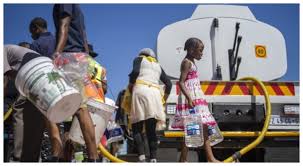
In Johannesburg, the region’s economic hub, supply disruptions have become widespread, with some communities going weeks without reliable water.
The situation has triggered protests, including residents bathing in public, underscoring the severity of the crisis.
According to Associated Press reporting in 2024, residents were forced to queue for water as pressure on the system intensified.
A five litre bottle of water was selling for about 25 rand ($1.30), highlighting the financial strain on households in a country where more than 32% of the population is unemployed.
Despite periods of heavy rainfall and dams reportedly operating at full capacity, shortages persist.
READ: Africa: Lesotho Tourism Levy for tourists goes operational, to create more jobs
Analysts say the crisis is not primarily driven by water scarcity, but by systemic failures. Municipalities have struggled to maintain reservoirs, pipelines and pumping stations, while new infrastructure has lagged behind demand.
In response, President Cyril Ramaphosa has established a national crisis committee and pledged more than 150 billion rand ($7.6 billion) in spending on water infrastructure and sanitation over the next three years.
Lesotho’s water becomes strategic asset
As South Africa struggles to stabilise supply, neighbouring Lesotho is emerging as a critical supplier, turning water into what many describe as “liquid gold”.
With an economy of just over $2 billion and largely dependent on textiles and diamond exports, water has become one of the most strategic revenue streams for the government.
The country of about 3 million people, entirely surrounded by South Africa, supplies water through a multi billion dollar project established in 1986.
At the centre of this relationship is the Lesotho Highlands Water Project, which channels water from Lesotho’s highlands to South Africa’s economic centres.
The system, built around the Katse and Mohale dams, transfers nearly 800 million cubic metres of water annually, equivalent to about 800 billion litres, and supplies around 60% of Johannesburg’s water needs.
According to Bloomberg, the project generates close to $300 million annually in royalties for Lesotho, accounting for about 15% of government revenue.
Nonetheless, officials are exploring options to increase returns, including expanding hydropower capacity and investing in floating solar projects, which could position the country as a net exporter of energy.
Lesotho moves to renegotiate terms
With the strategic value of water rising, Lesotho is seeking to renegotiate the terms of the decades old agreement with South Africa.
Natural Resources Minister Mohlomi Moleko said that talks are expected to begin in April, focusing on royalties and compensation related to a deal that accounts for more than 10 percent of the country’s economy, according to News24.
“We have to go back and look at the impact of compensation,” Moleko said. “If you give somebody compensation, you don’t want the person’s life to be worse off. It has to be higher.”
Officials say the current terms no longer reflect economic realities or development priorities.
Delays add pressure to already strained system
Efforts to expand supply through the second phase of the project have faced repeated delays, with completion now expected in 2030.
The delays risk prolonging shortages in South Africa, particularly in urban and industrial centres where demand continues to rise.
At the same time, extreme weather events are adding further strain. A Red Level 10 storm displaced hundreds of thousands across Mozambique, South Africa and Zimbabwe, highlighting the region’s vulnerability to climate shocks.
A resource reshaping regional power dynamics
As water scarcity intensifies across Southern Africa, Lesotho’s role as a key supplier is becoming increasingly strategic.
But with that leverage growing, the kingdom is pushing for a bigger share of the value it provides, signalling a shift in regional dynamics as water takes on the weight of a critical economic resource.
