
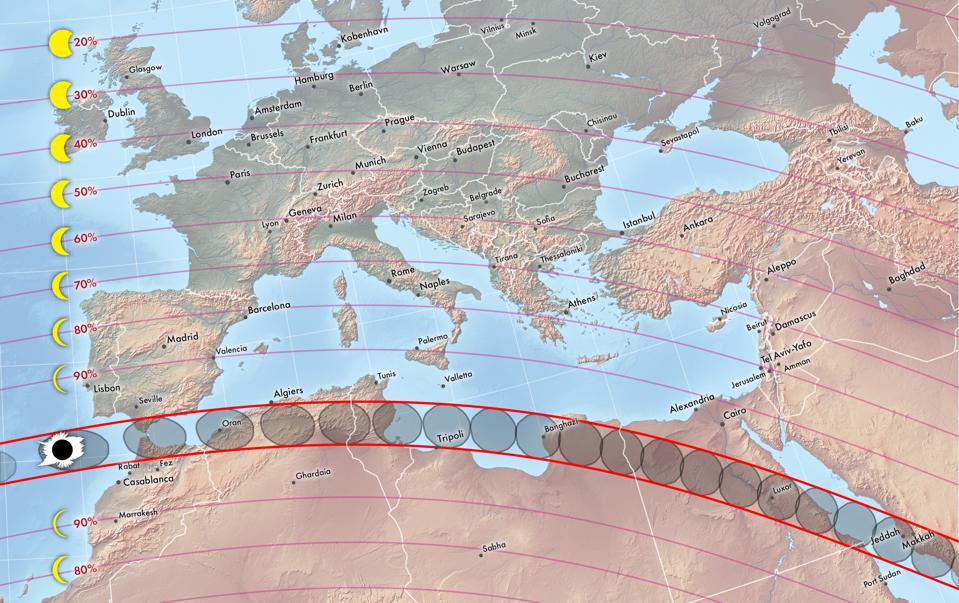
With exactly one year to go, astronomers, tourism operators and eclipse chasers are gearing up for what has been dubbed the “Eclipse of the Century”—the total solar eclipse of August 2, 2027, expected to be one of the most spectacular celestial events of the 21st century.
According to Forbes, the eclipse is attracting global attention because of its exceptionally long duration, with totality lasting up to 6 minutes and 23 seconds in some locations—making it the longest total solar eclipse visible from land for the remainder of this century.
READ: News: Century’s Longest Solar Eclipse to Cast Over Six Minutes of Darkness in August 2, 2027
The path of totality will stretch across southern Spain, Morocco, Algeria, Tunisia, Libya, Egypt, Saudi Arabia, Yemen and Somalia, plunging millions into daytime darkness as the Moon completely obscures the Sun and reveals its outer atmosphere, or corona. Forbes notes that the event is expected to trigger a tourism boom across destinations along the eclipse path, with hotels, flights and guided eclipse tours likely to be booked well in advance. The publication advises travellers planning to witness the phenomenon to make reservations early as demand is expected to far exceed available capacity.
Unlike shorter eclipses, the 2027 event will provide observers with an unusually long opportunity to experience totality, making it particularly valuable for scientific research, astrophotography and public observation. The extended duration also increases the likelihood of clear viewing conditions for eclipse enthusiasts travelling from around the world. The eclipse is expected to be especially significant for North Africa and the Middle East, where several countries lie directly beneath the path of maximum totality, positioning the region as a major destination for astronomy tourism in 2027. Forbes describes the event as a once-in-a-lifetime opportunity for many skywatchers, predicting that it will become one of the largest astronomy tourism events ever staged, with millions of people expected to travel to witness the rare celestial spectacle.
