
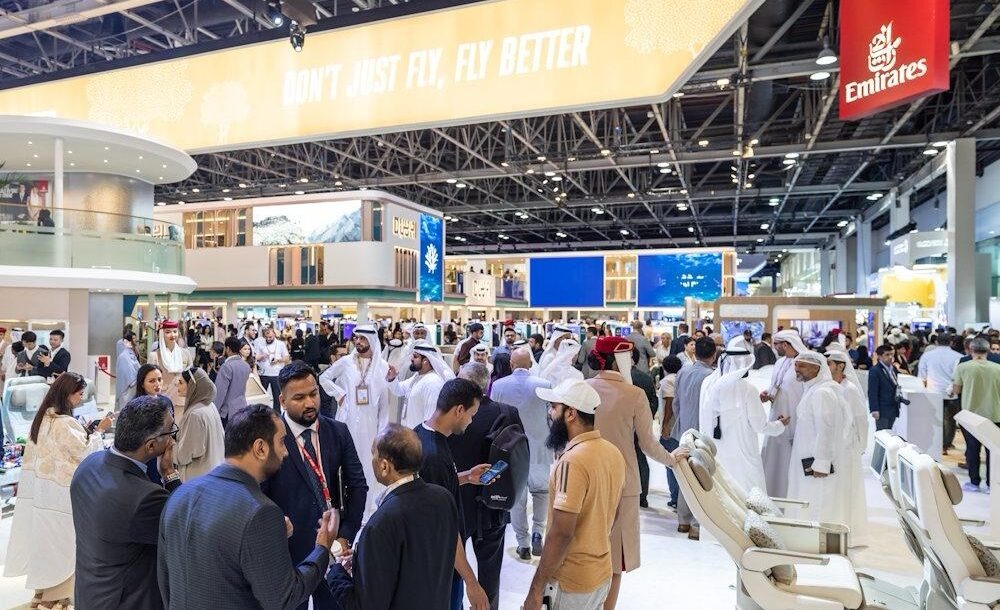
Arabian Travel Market (ATM) 2025 spotlighted the future of sea and air travel, bringing together global leaders from the aviation and cruise industries to explore new opportunities, partnerships, and innovations driving growth across both sectors.
In a compelling fireside chat on the Global Stage, Paul Griffiths, CEO of Dubai Airports, shared record-setting passenger figures and discussed how cutting-edge technologies like AI are transforming airport operations and the passenger experience.
Alongside Griffiths’ insights, a panel of cruise industry experts explored the region’s rapid evolution as a leading cruise destination, with a particular focus on the Arabian Gulf’s growing appeal.
Dubai Airports is on track for a historic year, with January alone welcoming 8.5 million passengers and full-year forecasts reaching 96 million. Griffiths underscored the strength of key markets including India, Saudi Arabia, the UK, and the USA—reinforcing Dubai’s role as a critical global aviation hub.
Highlighting Dubai Airports’ commitment to innovation, Griffiths emphasized the integration of facial recognition, AI, and customer-centric design to streamline the travel journey. He provided a glimpse into the vision for Al Maktoum International Airport (DWC), which will feature eight compact concourses aimed at minimizing transit times and enhancing comfort.
“Future customer preferences won’t be shaped solely by airfare or in-flight offerings,” Griffiths stated. “It’s the ease, convenience, and overall airport experience that will truly define travel decisions. Dubai Airports is committed to setting the global benchmark.”
On the cruise side, new data from Tourism Economics (an Oxford Economics company) revealed a 25% rise in global cruise deployment between 2019 and 2024, with a further 5% increase in early 2025. The Caribbean, Europe, and Asia-Pacific continue to lead, while the Middle East has seen a remarkable 125% surge in average cruise days.
Angelo Capurro, Executive Director at MSC Group’s Cruise Division, highlighted increasing interest from Central Asian travelers. “We saw passengers from over 150 nationalities last year, with notable growth from Central Asia due to improved connectivity, streamlined visa processes, and the region’s rising allure,” Capurro noted.
The panel credited regional infrastructure investments, collaborative efforts, and demand for immersive cultural experiences for the Middle East’s emergence as a premier cruise market. Key milestones discussed included the launch of Aroya Cruises—Saudi Arabia’s first luxury cruise line—and the strategic efforts of the Cruise Arabia Alliance to enhance passenger satisfaction across the region.
ATM’s Global Stage continues to serve as the epicenter for visionary dialogue, bringing together C-suite executives, policymakers, and global influencers through high-impact panels, interviews, and presentations designed to inform and inspire.
Concluding the week, the Global Stage featured an in-depth market insights session on the Asia-Pacific region and spotlighted India’s next-generation traveler, amid the country’s surging outbound tourism.
Danielle Curtis, Exhibition Director ME, Arabian Travel Market, reflected on the event’s success:
“This year’s ATM has hosted some of the world’s most forward-thinking leaders in tourism. From innovation and sustainability to new market opportunities, the insights shared here have truly shaped the narrative for the future of global travel.”
