
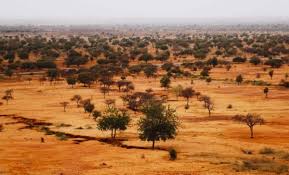
After repeated attempts to reverse desertification through large-scale tree planting failed across sections of the Sahel and Sahara regions, environmental researchers turned to an unusual solution — releasing 500 tortoises into the fragile ecosystem.
According to ndiandefencereview.com, the experiment is now drawing global attention after satellite imagery reportedly showed visible signs of ecological recovery in previously barren areas.
For years, extreme daytime temperatures exceeding 60 degrees Celsius and hardened soil surfaces prevented rainwater from penetrating the ground, leaving seeds unable to germinate and moisture evaporating almost instantly.
The harsh conditions frustrated reforestation campaigns and accelerated land degradation across the region. However, scientists say the tortoises helped naturally break up the soil crust, disperse seeds, and improve moisture retention, gradually creating conditions capable of supporting plant growth once again.
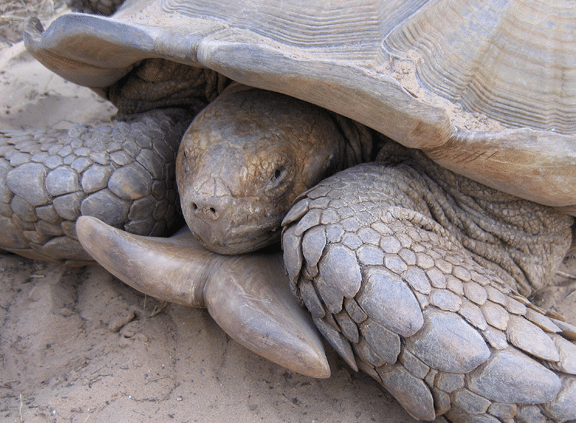
In 2021, researchers released 500 African spurred tortoises into a stripped-down landscape along the southern edge of the Sahara. The animals belong to a species, Centrochelys sulcata, that evolved to handle exactly these conditions. Five years later, satellite images captured scattered green patches pushing up through the sand.
The tortoises did not plant anything. They dug.
A Hundred-Kilo Shovel With Instincts
The African spurred tortoise ranks as the largest mainland tortoise in the world and the third-largest overall, behind the giants of the Galápagos and Aldabra. Adult males can weigh more than 100 kilograms. But size alone is not what altered the landscape. The trait that mattered was the animal’s drive to excavate.
To escape lethal ground temperatures, spurred tortoises carve burrows 10 to 15 meters below the surface, according to research compiled by the IUCN Tortoise and Freshwater Turtle Specialist Group. Each tunnel lets the tortoise survive the midday heat and the cold nights. It also punches through the sealed soil crust.
Once that crust breaks open, rainwater finds a path downward instead of sheeting off the surface. The surrounding soil gains water retention capacity. Moisture stays in the ground longer after each rainfall.
Conservation groups have already measured this effect in Senegal. The non-profit S.O.S. (Save Our Sulcata) has managed tortoise breeding and release programs since 1992. An IUCN report published in August 2020 described a sanctuary called the Village des Tortues in Noflaye, Senegal, holding more than 300 individuals. Researchers there have released dozens of tortoises back into the wild.
When a Tunnel Turns Into a Garden
The mechanism that follows is more physical than biological. A burrow entrance and the loosened soil around it create a pocket of stable microclimate. The tortoise does not carry or spread seeds deliberately. But seeds already lying dormant on the hardened surface, or seeds carried in by wind, find just enough moisture and shelter near the burrow to germinate.
Insects and microorganisms move into the loosened soil next. From there, the ecological chain builds outward. Over time, vegetation thickens around the digging zones. The green patches that appeared on satellite imagery were not forest canopies. They were clusters of plant life anchored to the spots where tortoises had been working.
Ecologists call organisms that physically reshape their surroundings for other species ecosystem engineers. A 2017 review published in Frontiers in Ecology and Evolution singled out the African spurred tortoise as an example that deserves more attention. The review noted that the species digs burrows with “great ecosystem engineering potential” because the tunnels are large, reaching 15 meters in length, and they appear in semi-desert environments where both cover and moisture are scarce.
That same review flagged a gap. The role of the spurred tortoise as a seed disperser remains poorly studied, meaning scientists do not yet know the full scope of what the species moves or plants across its range.
No Bulldozers, No Pipes, No Chemicals
The 2021 release of 500 tortoises drew attention, but IUCN records show that reintroduction work in Senegal began decades earlier. In one tracked group, tortoises posted an over 80 percent survival rate across four years of monitoring. That number matters because landscape effects cannot accumulate if the animals do not stay alive long enough to dig, move, and maintain their burrow systems.
No one brought in tree-planting equipment. There were no irrigation lines or chemical soil treatments. The intervention consisted entirely of releasing a native reptile into habitat from which human pressure had mostly erased it: hunting, expanding agriculture, and livestock grazing had all taken a toll.
What followed was gradual vegetation recovery on ground that had previously shown bare sand. What returned was not forest in the everyday sense. It was visible biodiversity, with birds and small vertebrates arriving once plant cover began to spread.
The Satellites Caught the Shift
The sequence, as the source material traces it, ran from digging to soil change to water to growth. Burrows altered the way water moved through the ground. Moisture held longer. Seeds began to germinate. Invertebrates showed up. Green cover spread in patches. Satellites captured the change over a five-year window.
The process echoes what farmers across the Sahel do by hand when they dig small water-harvesting basins to trap rainfall and concentrate organic matter. The scale and the persistence differ. A tortoise digs because its body demands it, and it keeps digging across its whole life.
The spurred tortoise adapted to desert margins over millions of years. Its burrowing is not a conservation technique invented by people. It is the species’s ordinary answer to extraordinary heat and cold. Where the tortoise had been removed, digging stopped. The surface sealed. Water ran off. Seeds failed. Putting the tortoise back meant restoring the digger.
Why the Sahara Is Not About to Vanish
The source reporting does not frame tortoise reintroduction as a universal fix for desertification in the Sahel. The region is tangled in overlapping pressures. Repeated droughts, grazing density, political instability, and steady habitat fragmentation all determine whether a recovered patch holds or vanishes again.
The IUCN categorizes the African spurred tortoise as Endangered. Populations are shrinking fast across most of its remaining range. The species has already been wiped out in multiple countries, likely including Cameroon, Djibouti, and Togo. An expert evaluation cited in the 2020 IUCN report attributed roughly 60 percent of the threat burden to habitat loss. Climate change accounted for about 25 percent.
Hunting for meat, use in traditional medicine, and collection for the pet trade made up the rest.
The same animal helping to regrow vegetation is fighting for survival in most places it still lives.
The tortoise experiment is “neither a magic bullet nor a universal solution.” Restoration success depends on rainfall, grazing control, and how the land is managed over time. What the project provides is a clear look at how a keystone species can restart dormant ecological machinery without heavy engineering.
