
Nigeria’s travel economy is projected to reach approximately $14 billion in 2025, up from about $13.5 billion in 2024, but remains uncompetitive globally despite steady growth, according to an industry analysis by Aeronexus Partners Ltd.
The report shows that tourism alone generated between $8.5 billion and $9.8 billion in 2024, contributing roughly 2.4 to 2.9 per cent of GDP, and is expected to inch toward $10 billion in 2025, with contribution approaching 3 per cent.
However, analysts say the growth—estimated at just $300 million to $500 million year-on-year—reflects resilience rather than transformation.
“The issue isn’t demand. Nigeria has demand in abundance. The issue is orchestration,” the report stated.
According to the firm, Nigeria continues to offer fragmented travel experiences instead of a unified tourism product, limiting its ability to scale value in the global market.
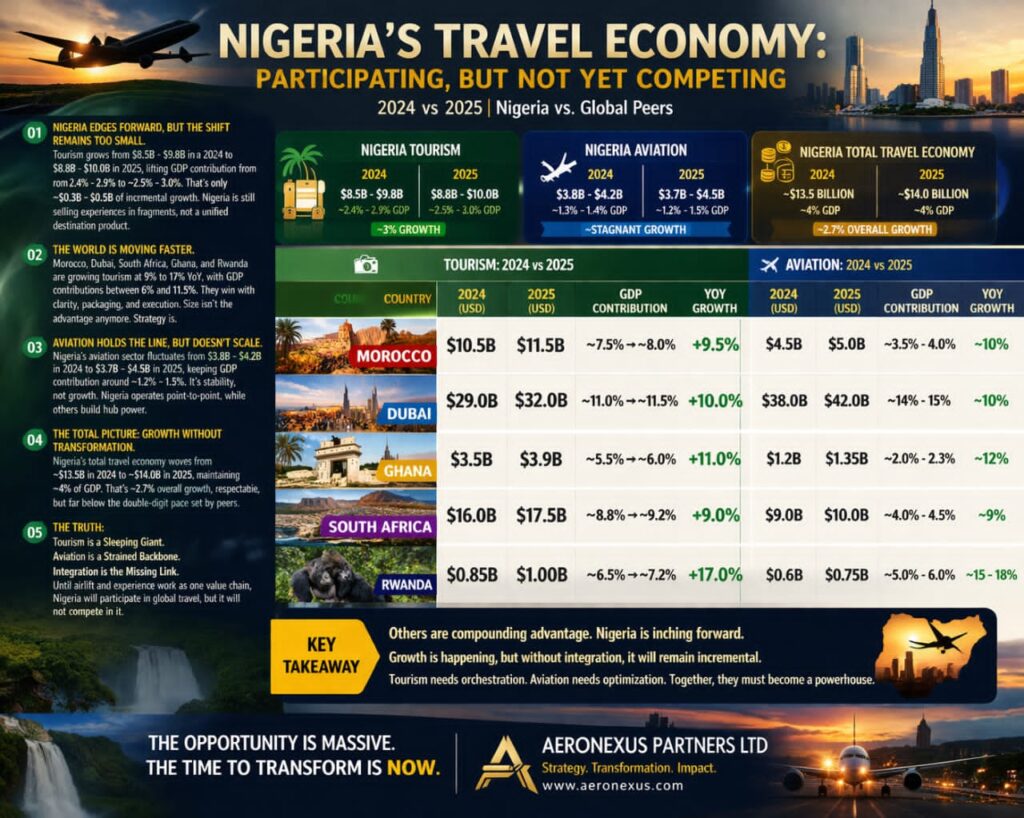
In comparison, peer destinations are recording stronger growth and higher economic impact. Morocco’s tourism revenue is projected to rise from $10.5 billion in 2024 to $11.5 billion in 2025, contributing about 8 per cent of GDP, while Dubai is expected to grow from $29 billion to $32 billion, accounting for over 11 per cent of its economy.
Similarly, South Africa is projected to grow tourism earnings from $16 billion to $17.5 billion, while Ghana and Rwanda are also recording faster growth rates and stronger GDP contributions.
On the aviation side, Nigeria’s sector generated between $3.8 billion and $4.2 billion in 2024, contributing about 1.3 to 1.4 per cent of GDP, and is projected to hover between $3.7 billion and $4.5 billion in 2025.
The report noted that the sector remains constrained by jet fuel volatility, foreign exchange pressures, and infrastructure limitations, preventing it from scaling in line with global benchmarks.
Globally, aviation is increasingly being used as a growth multiplier. Dubai’s aviation sector, for instance, is projected to grow from $38 billion to $42 billion, contributing up to 15 per cent of GDP, while Morocco, South Africa, Ghana, and Rwanda are also recording stronger expansion.
The analysis concluded that Nigeria’s travel economy—while growing at about 2.7 per cent—is not keeping pace with competitors due to a lack of integration between tourism and aviation.
“Tourism is a sleeping giant with high potential but low execution, while aviation is a strained backbone operating under pressure,” the report said.
Aeronexus Partners emphasised that unlocking growth would require building tourism as a cohesive ecosystem, positioning aviation as a hub-driven strategy, and integrating both sectors into a single value chain.
Industry experts say without such coordination, Nigeria risks remaining a participant rather than a leader in the global travel economy.
