

Despite rapid growth in global aviation, air travel remains largely inaccessible across Africa, where only an estimated 10 to 15 per cent of the continent’s 1.4 billion population has ever flown.
According to Gbenga Onitilo Principal Managing Partner, Aeronexus Partners Limited, the figure underscores a significant gap in connectivity and highlights deeper structural challenges in affordability, infrastructure, and access, raising questions about how inclusive the aviation industry truly is in one of the world’s fastest-growing regions.
Even more striking, Africa represents ~18% of the global population, but contributes just ~2.1–2.2% of global air passenger traffic, according to the International Air Transport Association. Globally, airlines carry roughly 4.5–5 billion passengers annually, yet Africa’s share remains disproportionately small.
At first glance, it’s easy to misread this as weak demand. It isn’t. The demand is there, alive, rising, and quietly waiting. The real issue is structural. Africa’s aviation story is not one of absence, but of constraint.
For many Africans, flying is still not a mode of transport, it is a milestone. Airfares across the continent remain among the highest globally when measured per kilometer. Taxes and charges are estimated to be 12–15% higher than global averages, and jet fuel, an airline’s single biggest cost line, can be up to 17% more expensive than in other regions. Layer on currency volatility, inflation pressures, and limited disposable income, and aviation becomes aspirational rather than accessible.
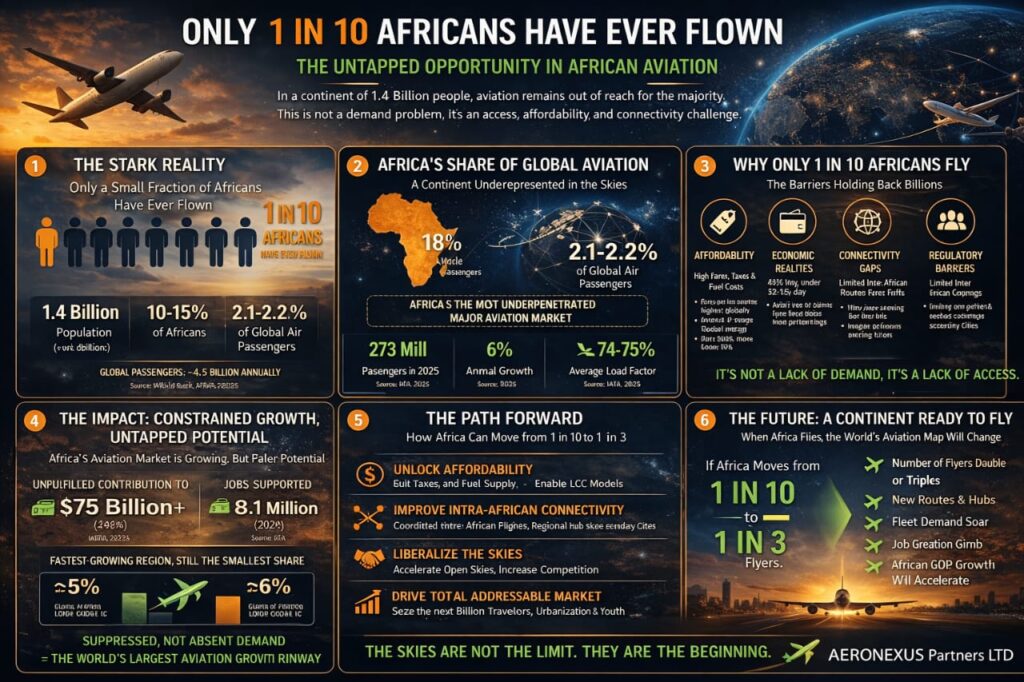
Then comes the geography of inefficiency. Traveling within Africa can feel paradoxically harder than leaving it. Routes are limited, frequencies are thin, and in too many cases, passengers must connect through Europe or the Middle East to reach neighboring African countries. It is not distance that complicates African travel, it is network design. A fragmented system trying to serve a unified need.
Policy has not helped enough. While frameworks for open skies exist, implementation has been slow and uneven. Bilateral agreements still dominate, restricting competition and keeping fares high. The result is a market where supply is constrained, prices remain elevated, and access is limited to a narrow segment of the population.
And so, a pattern emerges: planes are flying, but they are often filled by the same people. A relatively small group of frequent travelers, corporate executives, government officials, diaspora passengers accounts for a disproportionate share of air traffic. The mass market, the real engine of scale, is still largely grounded.
Yet, beneath this constrained system lies one of the most compelling growth stories in global aviation.
Africa is already one of the fastest-growing aviation regions, with passenger demand expanding at ~6% annually, outpacing global averages. Traffic is projected to reach over 270 million passengers in the near term, and continue climbing steadily. This is not a stagnant market, it is a suppressed one. Growth is happening, but below its true potential.
The implication is profound.
If Africa were to move from 1 in 10 people flying to even 1 in 3, the impact on global aviation would be seismic. Entire route networks would be redrawn. Fleet strategies would shift. New hubs would emerge. The center of gravity in aviation would begin to tilt.
But that transition will not happen by accident. It will require deliberate action, lowering the cost of travel, improving fuel and tax structures, expanding intra-African connectivity, and accelerating policy liberalization. It will require building networks that serve people, not just markets. And perhaps most importantly, it will require treating aviation not as a luxury sector, but as a strategic economic enabler.
Because aviation, when it works, does more than move people. It unlocks trade. It connects ideas. It accelerates opportunity.
The story of African aviation is still being written. Today, it is defined by limitation. Tomorrow, it will be defined by scale.
And when that shift happens, when more Africans begin to fly, not as an exception but as a norm, the numbers will change. But more importantly, the narrative will change.
From exclusion…
to access.
From constraint…
to possibility.
And from 1 in 10…
to a continent finally in motion.
