
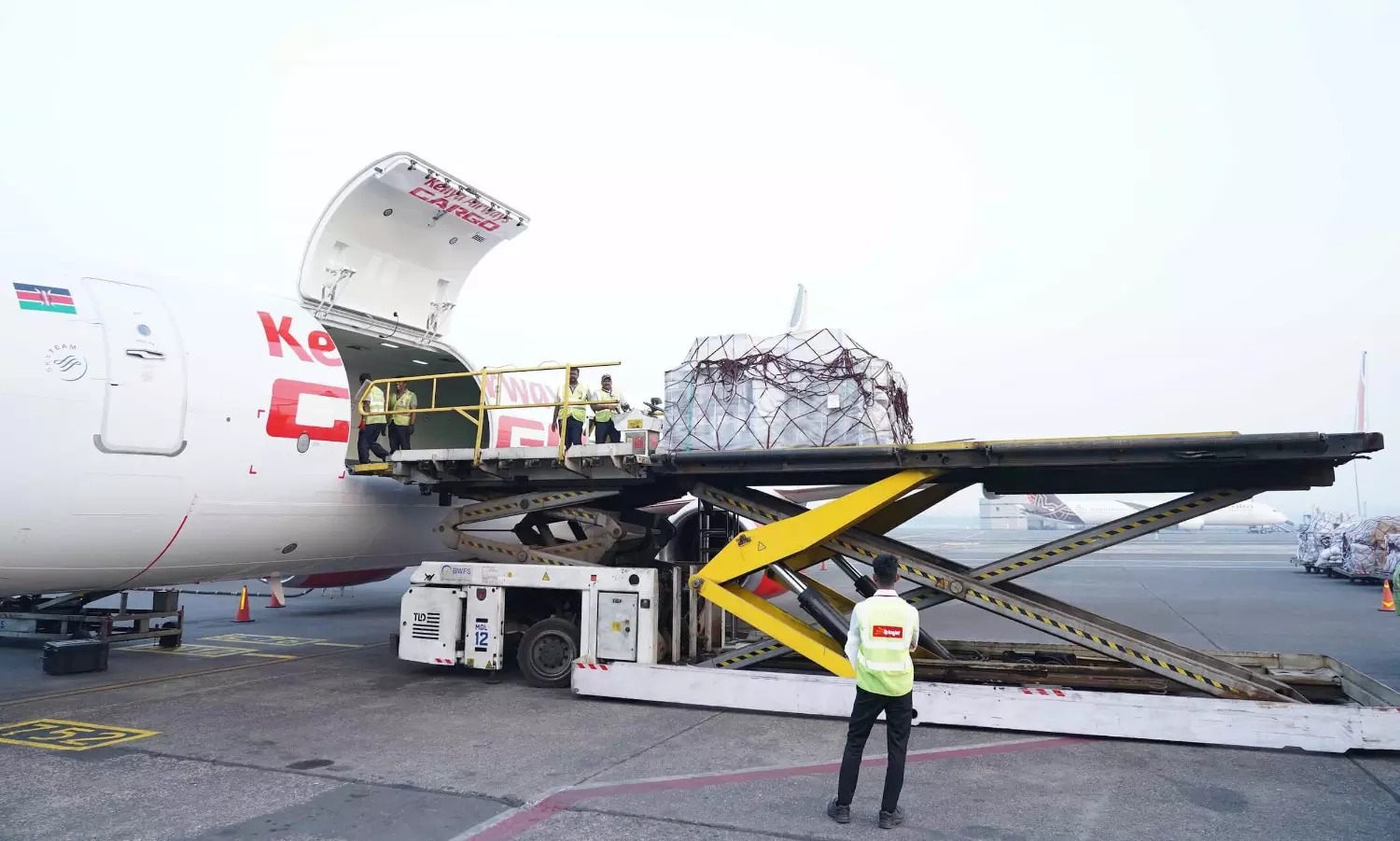
Global air cargo demand reached an unprecedented peak in October 2025, setting a new all-time high despite ongoing downward pressure on pricing.
The latest data indicates robust volume growth, even as the industry grapples with expanding capacity. According to Logistics Update Africa, international cargo tonne-kilometres increased 4.8% compared with last year. Africa led global growth with a sharp 16.6% rise, while Asia-Pacific maintained strong momentum with an 8.3% increase. Europe accelerated to 4.3% growth, but Latin America and North America reported contractions of 2.7% each.
Global capacity expanded 5.1% in October, pushing cargo load factors down 0.5 percentage points to 47.1%. African airlines recorded the strongest capacity increase at 20.0% year-on-year, while Middle Eastern carriers added 10.0%. Asia-Pacific capacity rose 7.3%, European carriers increased 4.3%, and North America saw only a 0.1% rise. Trade lanes showed varied performance. Europe–Asia continued to register strong double-digit growth at 11.7%, while Middle East–Asia demand rose 11.5%. Within Asia grew 9.0%. Asia–North America remained the weakest major route, falling 1.4% and marking its sixth consecutive monthly decline. Europe–North America grew 2.6%, and Europe–Middle East posted a slight 0.1% increase after two months of contraction. Asia–Africa added 10.9% and Africa–Middle East rose 13.5%.
READ: Aviacargo: Africa Leads Global Air Cargo Growth with 14.7% Surge — IATA
Belly-hold capacity strengthened across most corridors. From January to October, belly-hold accounted for 54.3% of international freight, up from 53.7% last year. In October, belly-hold capacity on North America–Asia jumped 23.9%, while Europe–Asia rose 6.5%, Europe–North America increased 2.4%, and Within Asia grew 11.4%. Freighter capacity grew 6.4% year-on-year but lost share overall as airlines shifted aircraft to higher-demand routes. Dedicated freighter ACTK on Europe–Asia increased 21.4%, Europe–North America rose 12.4%, and Within Asia grew 8.0%.
Jet fuel prices rose 2.5% year-on-year, extending the increase seen in September. The Brent–jet fuel crack spread widened 92.3% to USD 27.3, approaching levels seen in 2023 and 2022. Air cargo yields fell 4.7% in October as capacity grew faster than demand, bringing yields down to USD 2.46 per kilogram. Forward-looking indicators also supported the market. The global manufacturing PMI reached 51.45, marking three months of expansion, while new export orders slipped to 48.31. Industrial production increased 3.7% year-on-year in September, and global goods trade rose 5.3%, confirming firm underlying demand. Seasonally adjusted air cargo demand increased 3.4% in September, continuing more than two years of uninterrupted monthly growth.
Non-seasonally adjusted air cargo volumes expanded for the eighth straight month, supported by higher global output and trade. The analysis notes that 2025 has seen consistent yearly growth, with only a brief contraction in February.
