
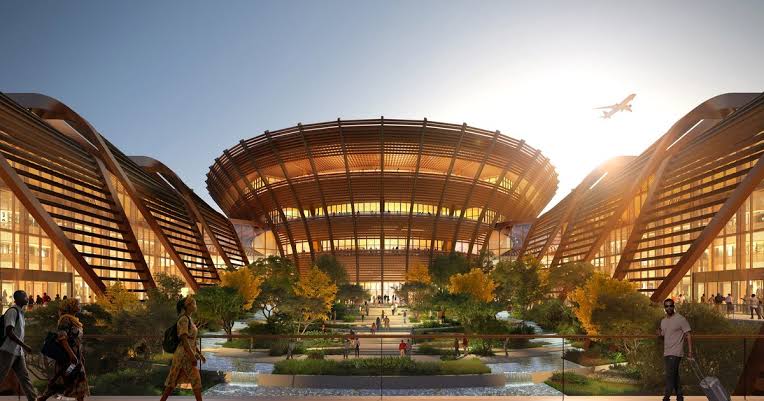
Ethiopia’s ambitious $12.5 billion Bishoftu International Airport project is drawing strong interest from Chinese state-owned companies, with no major independent U.S. contractor appearing among the shortlisted firms for key contracts.
According to businessinsider.com, the development is attracting attention in Washington as Ethiopia advances one of Africa’s most significant aviation infrastructure projects amid already strained U.S.-Ethiopia relations and regional tensions involving Egypt.
The U.S. is looking for ways to reassert its presence in the project after an earlier shortlist for Ethiopia’s $12.5 billion airport excluded major American contractors.
Ethiopian Airlines completed prequalification for four major construction packages in April, attracting companies and joint ventures from China, Europe, the Middle East, Türkiye, India and Russia.
Chinese firms secured 15 of the 33 places on the shortlist, either independently or through joint ventures, spanning 10 groups.
They include China Communications Construction Company, China Road and Bridge Corporation, China Civil Engineering Construction Corporation and Beijing Urban Construction Group.
READ: Africa: U.S. Eyes Role in Ethiopian Airlines’ $12.5 Billion Mega Airport Project
The four packages cover the main terminal and airport facilities, airfield works, supporting infrastructure and offsite transport links.
By contrast, no independent American contractor was shortlisted, except Connecticut-based Lane Construction Corporation, which is owned by Italy’s Webuild and appears in three packages through a joint venture with Webuild and Türkiye’s IC İçtaş.
Ethiopian Airlines has not yet awarded the contracts, with contractor selection pushed from August 2026 to early January 2027 after bidders requested more time to prepare proposals and arrange financing.
Group Chief Executive Mesfin Tasew said the delay would not affect the overall project schedule.
As the procurement process continues, Washington has shifted its focus towards securing a broader role for U.S. companies beyond civil construction.
Mark Mitchell, the U.S. Deputy Assistant Secretary of Commerce for the Middle East and Africa, said in July that the Commerce Department had been closely engaged in efforts to secure strong American participation in the project.
U.S. officials have pointed to Boeing and GE Aerospace as companies that could benefit from opportunities in aircraft, engines, aviation technology and equipment linked to Ethiopian Airlines’ expansion.
In April, Ethiopian Airlines agreed to buy six additional Boeing 787-9 aircraft, adding to 20 already on order.
More than $9 billion in external financing required
Ethiopian Airlines plans to fund about 30% of the $12.5 billion project from its own balance sheet, leaving lenders to provide more than $9 billion.
Mesfin said lenders had indicated interest worth about $8.5 billion, although no final loan agreement covering the bulk of the external financing had been signed.
The African Development Bank is acting as mandated lead arranger and has indicated it will provide $500 million, subject to appraisal, while helping mobilise additional financing.
Interest has also come from the U.S. International Development Finance Corporation, the U.S. Export-Import Bank and JPMorgan Chase.
Chinese lenders are also in discussions over the project. Ethiopian Airlines and Ethiopia’s finance ministry have held talks with Bank of China, China Exim Bank, Industrial and Commercial Bank of China and China Development Bank.
Mesfin said in November 2025 that an unnamed China-based institution had pledged $500 million.
Washington seeks a larger role
The U.S. push for a larger commercial role comes against a history of strained relations with Ethiopia, including disagreements over the Grand Ethiopian Renaissance Dam on the Blue Nile.
Washington previously became involved in negotiations between Ethiopia, Egypt and Sudan, while Addis Ababa accused the U.S. of favouring Cairo during the dispute.
The airport project now offers another channel for economic engagement, particularly through financing, aircraft, engines and aviation technology.
Africa’s largest airport project
Bishoftu International Airport is being developed south of Addis Ababa to ease pressure on Addis Ababa Bole International Airport, which handles about 25 million passengers a year and is expected to reach capacity within the next few years.
The first phase of Bishoftu is designed to handle 60 million passengers annually when it opens in 2030, rising to 110 million passengers and about 3.73 million metric tonnes of cargo at full build-out, with parking for around 270 aircraft.
At $12.5 billion, Bishoftu is the most expensive aviation infrastructure project undertaken in Africa. Its planned annual passenger capacity of 110 million would also place it among the world’s largest airports by throughput.
